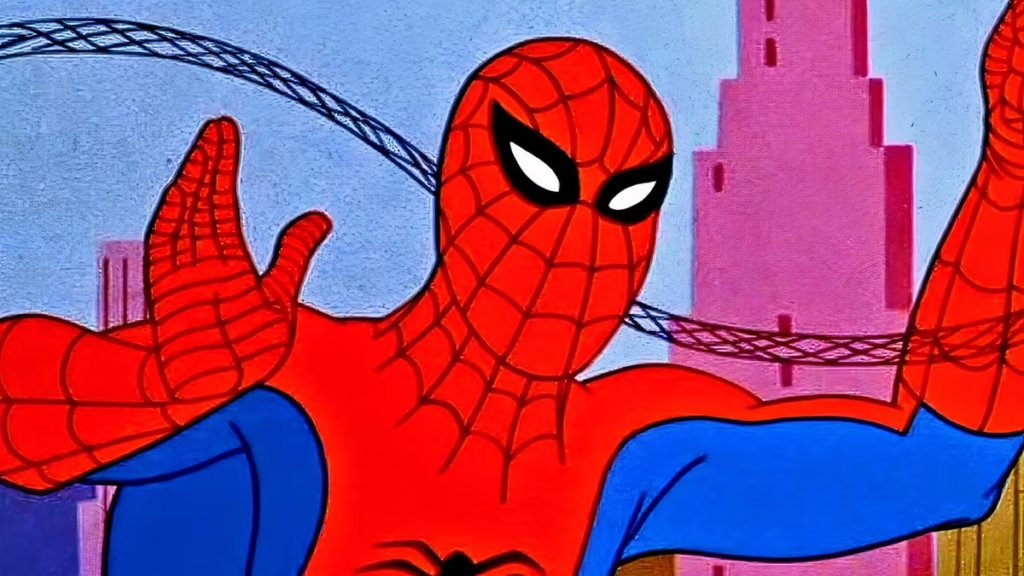
My childhood summers were filled with reruns of the original 1967 Spider-Man series. Back then, if it was on, I was watching. Every episode proudly announced it was presented in “In Color,” and as a kid I thought that sounded like the coolest thing in the world. I had no idea what Technicolor actually was, but if Spider-Man had it, then it had to be something special. Looking back, I realize that “In Color” did a lot of heavy lifting. In 1967, color television was still making its way into living rooms, and many families were still watching on black-and-white sets.
Saturday mornings had their own rhythm. A bowl of cereal, the television warming up, and then those unmistakable opening horns. Before Spider-Man threw his first punch or fired his first web, the music had already convinced you something exciting was about to happen. I couldn’t have explained what Technicolor meant back then, but I knew it sounded important. Maybe that’s why those opening horns hit even harder.

Looking back now, it’s obvious the series was constantly fighting its budget. After Grantray-Lawrence Animation folded following the first season, filmmaker Ralph Bakshi inherited the show with only a fraction of the original funding and was forced to reinvent almost everything. Recycled animation, repeated swinging shots, and moody watercolor backgrounds became part of the show’s identity. Yet it never felt lifeless because the music did the heavy lifting. Those cool jazz cues, punchy brass, and walking basslines gave every scene a sense of momentum, convincing our imaginations the animation was better than it actually was.
I always gravitated toward the second and third seasons because of those incredible KPM Library Music cues. The cool jazz, swinging brass, and funky basslines gave the series a personality far richer than its visuals suggested. We never complained about the recycled animation because this was the best Spider-Man we had.
It wasn’t my imagination. There was a reason those later seasons felt so different. Bakshi didn’t have the resources to make another Season 1, so he made a different kind of Spider-Man. Peter Parker spent less time at the Daily Bugle trading barbs with J. Jonah Jameson and Betty Brant and more time battling mysterious creatures, strange scientists, and bizarre monsters. The familiar New York of the first season gradually gave way to moody watercolor cityscapes and dreamlike worlds unlike anything else on Saturday mornings. Somehow, the jazzy soundtrack fit that stranger world perfectly.
One thing always amused me. After the Kingpin promised to squash Spider-Man “like a cockroach,” Spider-Man kept swinging past what looked like his headquarters week after week. I remember wondering why he never stopped in to see if the Kingpin was still there. Apparently, I was worrying about continuity years before I even knew there was a word for it.
Everyone knows the lyrics, even if they’d rather not admit they’re humming them at three in the morning. Written by Paul Francis Webster and Bob Harris, the theme became one of the most recognizable pieces of television music ever created. Recorded in London with some of Britain’s finest session musicians, reportedly to avoid higher American union costs, it drew on crime jazz, surf rock, and the blues rather than the traditional superhero march. The result sounded less like a superhero anthem and more like the soundtrack to a hard-boiled detective movie.
That style fit Spider-Man perfectly. Peter Parker wasn’t polished like Superman. He was awkward, improvising, and constantly thinking on his feet. The music swung, stumbled, recovered, and kept moving, just like he did.
The background music was every bit as important. Rather than commission a new score for every episode, the producers licensed tracks from Britain’s booming Library Music scene through publishers like KPM, De Wolfe, and Chappell. Recorded by world-class session musicians in studios that included Abbey Road, these weren’t disposable stock tracks. They became the heartbeat of the series. Those musicians probably had no idea they were creating one of television’s most enduring soundtracks. To them, it was another day’s work. To millions of kids, it became the sound of Spider-Man.
The story has one final twist. Decades later, producers like MF DOOM, Madlib, and J Dilla went digging through those same Library Music recordings for drum breaks, basslines, and horn riffs, giving Spider-Man’s soundtrack an unlikely second life in hip-hop. Music originally licensed to help stretch the budget of a Saturday morning cartoon ended up inspiring some of the most respected names in modern music.
Looking back, I realize I didn’t keep returning to the original Spider-Man because of its animation. I came back because of its sound. Long after I forgot which monster Spider-Man was fighting that week, I remembered how the episode sounded. Those jazzy brass stings, walking basslines, and unforgettable theme glued together a series that was constantly reinventing itself just to survive.
Today, the 1967 series is often remembered through internet memes, usually poking fun at its stiff animation and recycled cels. I get the joke, but I think that’s only half the story. Stop looking for a moment and just listen. Beneath those handmade imperfections is one of the coolest soundtracks ever to accompany a Saturday morning cartoon.
Looking back, the real magic wasn’t the color. It was the sound. Nearly sixty years later, those opening horns still take me right back to Saturday morning, sitting cross-legged in front of the television, waiting for Spider-Man to swing across the screen one more time.
Maybe that’s why those old cartoons have never really left us. Cheap childhood animation often outlasts polished CGI because its flaws invited our imaginations to finish the job. The recycled cels, painted backgrounds, and unforgettable jazz soundtrack weren’t limitations. They were invitations. We met the animators halfway, and together we built a Spider-Man that has been swinging through our memories ever since.

If this article made you think, brought back a memory, or made you see something differently, I’d love to hear from you. Send me an email at sandboxworld@gmail.com. I read every message personally and, with your permission, may feature your thoughts in a future article because the best stories are the ones we share.
Discover more from Sandbox World
Subscribe to get the latest posts sent to your email.