
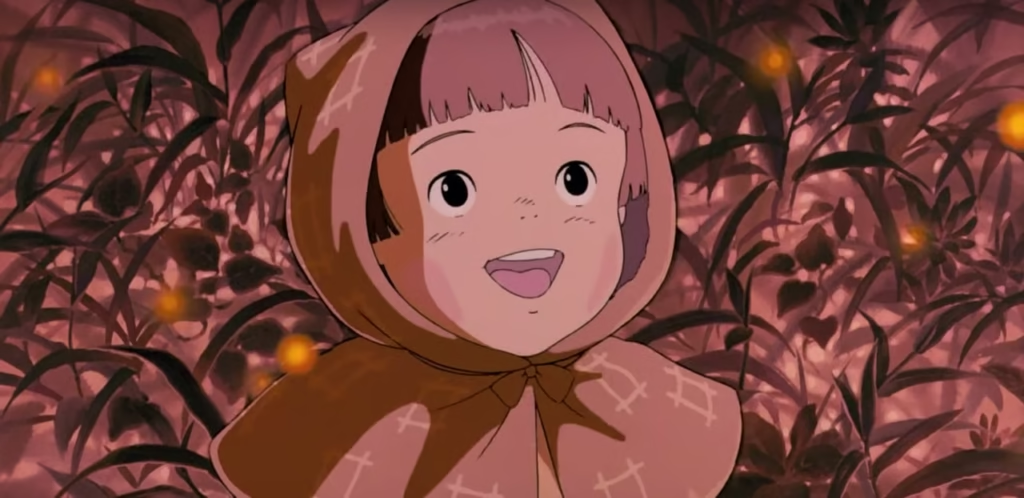
Studio Ghibli’s 1988 classic Grave of the Fireflies is not exactly what you would call a casual night at the movies. Decades after its release, the film still holds a flawless 100% rating on Rotten Tomatoes, and its recent crowning as the “Best War Movie of All Time” has sparked another round of passionate debate among film fans. Safe to say, if you’re looking for a casual popcorn flick, this isn’t it.
Japanese animators have never been afraid to tackle the big questions about life, death and everything in between. Unlike much of the animation produced elsewhere, Japanese animation has a long history of taking adult themes head-on, without feeling the need to soften the message or pretend that animation is automatically meant for children. Grave of the Fireflies is perhaps one of the most powerful examples of that approach.
For decades, plenty of Western audiences treated animation like a babysitter in a box, something to keep the kids quiet for ninety minutes. Grave of the Fireflies is one of the strongest arguments ever made against that idea. Director Isao Takahata used animation to tell a story with an emotional weight that would be difficult to capture in almost any other medium. There are no larger-than-life heroes, no convenient rescues and certainly no Hollywood ending waiting around the corner.

The late Roger Ebert was one of the film’s most vocal champions, recognizing that it completely challenges our ideas about what animation can accomplish. This isn’t a cartoon trying to convince us that it is a serious movie. It is serious cinema, full stop.
There is also something almost bizarre about the movie’s original release. Grave of the Fireflies was released in Japan alongside another Studio Ghibli film, My Neighbor Totoro. Think about that for a moment. On one side, you have one of the most comforting and beloved animated films ever made. On the other, you have a story about two children caught in the middle of the devastation of war. Imagine being a parent thinking you were taking the kids to see a nice animated movie and ending up with Grave of the Fireflies. That is one memorable way to ruin everyone’s evening.
What makes the film even more powerful is that Seita and Setsuko aren’t soldiers. They aren’t politicians, generals or people making decisions about the war. They’re just two children trying to find food, shelter and some sense of normal life while everything around them is falling apart.
They don’t care about military strategy or why the war started. They just want to survive. That makes their story feel much bigger than the particular conflict being depicted. These could be children caught in almost any war, in almost any country, at almost any point in history.
Ask almost anyone who has seen Grave of the Fireflies and you’ll probably get some version of the same response: “It’s an incredible movie. I never want to watch it again.” And honestly, that tells you a lot.
What makes the film so devastating isn’t military strategy, battlefield heroics or even the destruction caused by the bombs. It is the story of two orphaned siblings simply trying to survive the firebombing of Kobe. The bombs are horrific, but the real gut punch comes afterward. We watch as the people around these children become increasingly indifferent to their suffering.
The film slowly turns from a story about surviving war into something even more painful: a story about what happens when a society stops caring about the people who need it most. That is a much harder thing to watch.
It is tempting to call Grave of the Fireflies the definitive anti-war movie. Plenty of people do. But Takahata himself pushed back against that interpretation. He saw the film less as a grand political statement and more as a tragedy about isolation, selfishness and the failure of a community to protect its most vulnerable members.
And that distinction is important. Of course, once somebody declares a movie the “Best War Movie of All Time,” the film world is going to start throwing contenders into the ring. That is when Elem Klimov’s utterly devastating 1985 Soviet masterpiece Come and See inevitably enters the conversation.
So, is Grave of the Fireflies really the greatest war movie ever made? That probably depends on what you think a war movie is supposed to accomplish.
If you want tanks, battles and generals, there are plenty of other contenders. If you want a film that shows what war does to ordinary people, particularly the people who have absolutely no say in starting it, Takahata’s masterpiece has a very convincing argument.
Just don’t expect to finish it and immediately think, “Well, that was fantastic. Let’s watch it again.” You may sit in silence instead, staring at the credits while the room feels impossibly empty, wishing you could somehow reach back through the screen and save two children the world had already abandoned.
Recommended Reading
Inside Sandbox World
- Why Anime Is So Much More Than Cartoons for Kids — A natural companion to the discussion of Japanese animation and its willingness to tackle serious adult themes.
- The Films That Changed the Way We Look at Animation — Supports the article’s larger argument that animation deserves to be treated as serious cinema.
More on the Web
- Roger Ebert’s Grave of the Fireflies Review — Ebert’s influential perspective on Takahata’s film and its importance as serious cinema.
- BFI: Grave of the Fireflies — Additional critical and historical context about the film, Takahata and its place in Japanese cinema.
Discover more from Sandbox World
Subscribe to get the latest posts sent to your email.