

I will never be a soccer fan. Or football, as the rest of the world calls it. I’m a North American sports guy through and through. Give me baseball in the summer, hockey in the winter, football on Sundays, and basketball when the playoffs roll around. Those are the sports I grew up watching, and after all these years, I don’t see that changing.
That doesn’t mean I can’t appreciate a great story.
One of the reasons I’ve kept Sandbox World going for all these years is that I still enjoy learning something new. I love going down rabbit holes. I’ll start reading about a forgotten television show and somehow end up researching comic books. I’ll look up an old movie and find myself reading about the actor who almost got the role instead. Sometimes an album leads me to a documentary. Sometimes a toy leads me to a cartoon I haven’t thought about in decades. That’s one of the great things about pop culture. One interesting discovery almost always leads to another.
I certainly never expected a soccer team from Norway to send me down one of those rabbit holes.
Like millions of people around the world, I found myself fascinated by Norway and its supporters during the 2026 FIFA World Cup. At first, it was just another clip on social media, but before long, I was reading about Viking history, ancient runes, graphic design, typography, Led Zeppelin, Norse mythology, and even the origin of the Bluetooth logo. Somewhere along the way, I stopped reading about soccer and started reading about history. Honestly, I wasn’t expecting that detour, but I’m glad I took it.
The first thing that caught my attention was the now-famous Viking Row. Thousands of Norwegian supporters sit shoulder to shoulder, whether they’re inside the stadium, gathered in city squares, or even riding public transportation. A traditional Norse horn echoes through the crowd before everyone begins rocking back and forth in perfect rhythm, recreating the motion of rowing a Viking longship. A drum keeps the beat while the crowd shouts “Ro!”, the Norwegian word for “row,” every couple of strokes. The pace begins slowly, builds with every movement, and eventually explodes into a celebration that is every bit as entertaining as the match itself.
What impressed me wasn’t simply the spectacle. It was the coordination. Watching thousands of strangers move together with such precision is almost hypnotic, and for a few moments, the game itself becomes secondary. The supporters aren’t simply watching the action. They become part of it.
There is also something refreshing about watching fans who aren’t trying to intimidate anyone or insult the opposing team. They’re celebrating where they come from and embracing their own history. The Viking Row isn’t about putting someone else down. It’s about proudly saying, “This is who we are.” In today’s sports world, that’s a message worth celebrating.
Every sport has traditions that become part of its identity. Baseball has the seventh-inning stretch. Hockey has whiteouts during the playoffs. Football has unforgettable entrances that send entire stadiums into a frenzy before the opening kickoff. Professional wrestling has spent decades teaching us that an entrance can become just as legendary as the performer. The moment the music hits, the crowd knows exactly what’s coming. Norway has managed to create that same anticipation. The instant the Viking horn sounds, you know you’re about to witness something memorable.
One of the things I enjoy most about the World Cup is that, every four years, it introduces us to countries, traditions, songs, customs, and cultures that many of us might never have explored otherwise. For a few weeks, the tournament becomes much bigger than the final score. It becomes a worldwide celebration of identity, and that’s something every sports fan can appreciate, even if soccer isn’t their first love.
That’s what great pop culture has always done. It opens a door. You might come for the sport, but you leave wanting to learn about Viking history, Norse mythology, graphic design, music, or even why the Bluetooth logo looks the way it does. The best stories almost always lead to another story.
What I appreciate even more is that it doesn’t feel like something created by a marketing department after six months of focus groups. It feels genuine. Norwegian supporters created something that reflected their heritage, and the world embraced it because authenticity is hard to fake. Twenty years ago, most of us outside Europe probably never would have seen it. Today, a thirty-second video can travel around the world before halftime.
As much as I enjoyed the Viking Row, something else immediately caught my eye.
The jerseys.
I’ve always been fascinated by great graphic design, and Norway may have one of the most distinctive uniforms I’ve seen in years. The lettering is sharp, angular, and instantly recognizable. It looks ancient without feeling old-fashioned, giving the team a visual identity unlike anyone else on the pitch.
If I’m being honest, I probably would have stopped to read this story because of the jerseys alone. I’m a sucker for great design, whether it’s an album cover, a comic book logo, a baseball cap, a restaurant sign, or a movie poster. Good design has a way of pulling you in before you even know the story behind it.
I’ve always believed that a great uniform can make you appreciate a team you don’t even cheer for. People wear New York Yankees hats without following baseball. You’ll see someone in a Chicago Bulls jersey who couldn’t tell you the starting lineup. Sports uniforms have become part of pop culture, and Norway’s belong in that conversation. It’s one of those rare designs that makes you stop and take a second look.

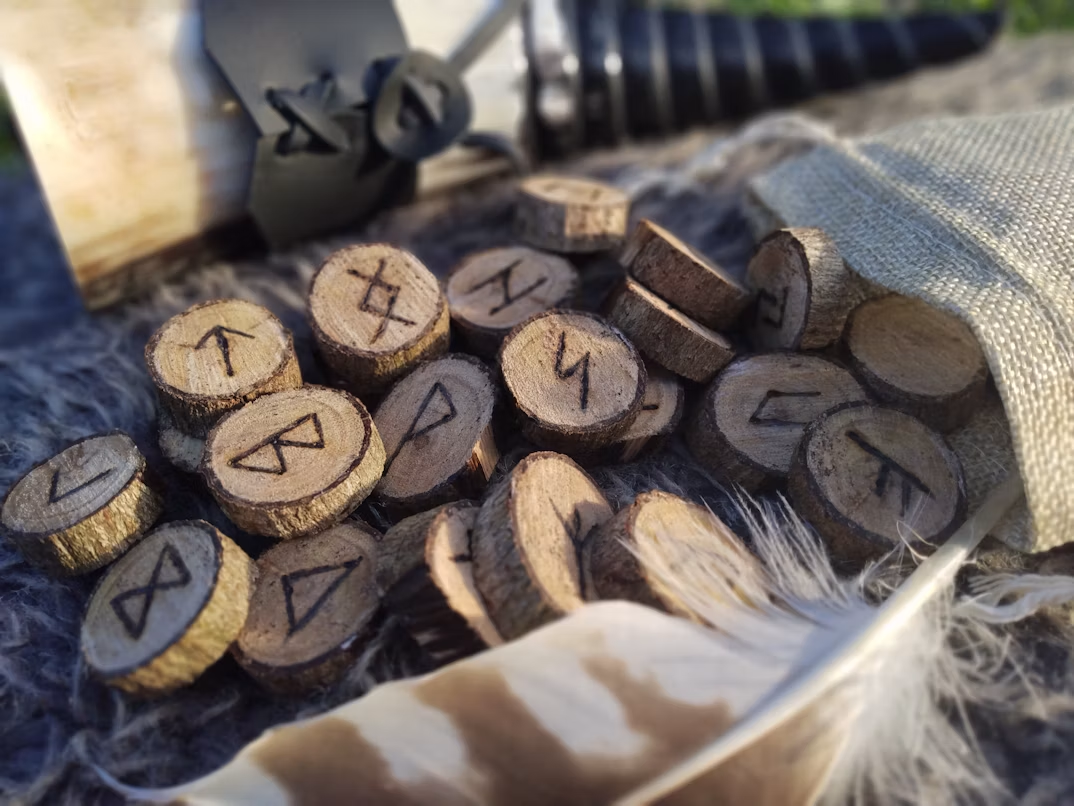
The custom typeface, Taakeferd Condensed, draws its inspiration from the Elder Futhark, the oldest known runic alphabet used by the early Germanic and Norse peoples. The name roughly translates to “Journey Through the Fog,” a fitting description for a nation returning to the World Cup after a 28-year absence.
Ironically, the original version of the font never survived FIFA’s rulebook. Nike unveiled a far more elaborate runic-inspired design in 2024, but officials considered the numbers too difficult to read during matches. Rather than abandoning the idea, the designers refined it into a cleaner, single-colour version that still honoured Norway’s Viking heritage while satisfying FIFA’s regulations. Sometimes creative restrictions force designers to produce their best work.
Typography has always fascinated me because it tells a story before you read a single word. You instantly recognize the Coca-Cola script, Disney’s whimsical lettering, or the bold logos used by countless heavy metal bands. Norway’s jerseys accomplish the same thing. One glance tells you exactly who’s on the field. That’s branding at its best, and companies spend fortunes trying to achieve that kind of recognition.
If the uniforms looked familiar, there was a good reason.
Long before fantasy movies, comic books, and video games embraced Viking mythology, Led Zeppelin introduced millions of music fans to runic imagery through the symbols used on Led Zeppelin IV. Every time I looked at Norway’s uniforms, I couldn’t help but hear The Immigrant Song playing in my head. If there was ever a national team that deserved its own soundtrack, this one might be it.
Runes have quietly become one of pop culture’s favourite visual languages. The Hobbit and The Lord of the Rings introduced generations of readers to ancient-inspired writing systems. Students at Hogwarts study Ancient Runes, while the Marvel Cinematic Universe has woven runic imagery throughout the stories of Thor, Odin, and Loki. Games such as God of War Ragnarök, The Elder Scrolls V: Skyrim, and Elden Ring use runes to represent mystery, forgotten knowledge, and ancient power. Television series like Vikings have only strengthened our fascination with Norse history.
One of my favourite discoveries was realizing that the Bluetooth logo sitting on our phones isn’t just an abstract symbol. It’s actually a combination of two runes representing the initials of King Harald Bluetooth, the Viking ruler who united parts of Scandinavia more than a thousand years ago. It’s amazing how often history quietly finds its way into our everyday lives.
Norway has a population of only about five and a half million people, yet it has spent decades punching above its weight in international competition. Whether it’s skiing, biathlon, or the Winter Olympics, the country has built a remarkable sporting tradition. Maybe we shouldn’t be surprised that it has now found another way to stand out on one of the biggest stages in sports.

Of course, having one of the world’s best players doesn’t hurt either. Erling Haaland has become the face of Norwegian soccer, but even he isn’t the whole story. Superstars attract attention. Culture keeps people watching.
One thing I’ve noticed over the years is that I enjoy discovering things outside my comfort zone. I probably won’t sit down and watch an entire soccer season, and I still couldn’t explain the offside rule with complete confidence. Apparently, though, I’m more than willing to spend an afternoon reading about Viking typography, Norse mythology, and the history behind a jersey. Sometimes it isn’t about becoming a fan. Sometimes it’s simply about appreciating why millions of other people are.
Maybe that’s why Norway has captured the imagination of so many people who don’t normally follow soccer. They’re not trying to imitate anyone else. They’ve embraced their own history, their own traditions, and their own identity. In a tournament filled with extraordinary athletes, they’ve reminded us that sometimes the most memorable stories happen in the stands instead of on the field.
Who would have imagined that an alphabet carved into stone centuries ago would inspire a modern sports uniform? Who would have guessed that a Viking rowing ritual would become one of the defining images of a World Cup? That’s the beauty of curiosity. You never know where it will take you.
I still won’t become a soccer fan. Tomorrow I’ll probably be reading about comic books, old television shows, baseball cards, forgotten movies, or vintage toys. But for one afternoon, Norway reminded me why I started Sandbox World in the first place.
To discover something unexpected, to learn something new, to share it with someone else, and maybe send them down their own rabbit hole. If that rabbit hole happens to begin with a Viking horn and end with Led Zeppelin, even better.
Ro!
Discover more from Sandbox World
Subscribe to get the latest posts sent to your email.