


There are movies where the music supports the story. Then there’s Once Upon a Time in the West, where the music practically is the story.
One of the most fascinating things about Sergio Leone’s 1968 masterpiece is that the score came first. Long before the cameras rolled, composer Ennio Morricone had already written the film’s major themes. Leone didn’t wait until post-production to add music. He brought Morricone’s compositions directly onto the set, blasting them through speakers while filming. Actors performed to the rhythms, emotions, and moods of the score, while camera movements were choreographed around the music itself.
Imagine being Charles Bronson, Jason Robards, Henry Fonda, or Claudia Cardinale and hearing those haunting melodies as you act out some of the most iconic scenes in Western history. Crew members reportedly became emotional simply hearing the soaring, wordless vocals of the main theme echoing across the Spanish landscape.
One of the things that makes Once Upon a Time in the West so mesmerizing is the way people move. Nobody rushes. Nobody wastes a step. Every walk, glance, and pause feels deliberate, as if the characters already know they’re living through the final days of the Old West.
The famously slow pacing isn’t there just to build tension. It’s Leone’s way of showing a world that is disappearing. These are men who live by guns, personal codes, and old grudges, standing in the path of something bigger than themselves. The railroad is coming, bringing noise, industry, and progress. The characters move like they’re trying to hold back time itself.
Even the gunfights feel different. Leone stages them less like action scenes and more like ceremonies. The real drama happens before anyone pulls a trigger. Characters circle each other, stare each other down, and wait. The tension becomes almost unbearable. When violence finally arrives, it feels less like a fight and more like the closing act of a death dance ritual.

That’s what makes the film so powerful. Every movement, every pause, and every stare contributes to Leone’s larger message. This isn’t just a Western. It’s a farewell to the mythology of the West itself.
Morricone’s score functions almost like a second screenplay. Every major character receives a distinct musical identity.
Charles Bronson’s Harmonica barely moves more than he has to. He’s calm, silent, and relentless. He drifts through the film like a ghost carrying unfinished business. Every step feels inevitable, as though fate has already decided where he’s headed. Harmonica’s theme is built around a sharp, unforgettable three-note harmonica phrase. It is less a melody than an obsession, reflecting a man driven entirely by revenge.
Henry Fonda’s Frank is different. He still carries himself with the swagger of a classic gunslinger, but you can see the cracks forming. He wants to become part of the new world of businessmen and railroad barons, yet he can’t escape his violent instincts. Frank is a man caught between two eras, and he belongs fully to neither. Frank’s theme introduces a distorted electric guitar, creating an unsettling and aggressive sound that perfectly captures Henry Fonda’s cold-blooded villain. As the mystery connecting Frank and Harmonica unfolds, their themes gradually begin to intertwine.
Jill McBain receives the film’s most beautiful musical moment. Accompanied by the soaring voice of Edda Dell’Orso, her theme represents hope, civilization, and the possibility of a future beyond violence.
Cheyenne’s theme feels almost playful by comparison. Double bass plucks, whistles, wood blocks, and honky-tonk piano create the sound of a wandering outlaw whose charm hides a deeper sadness.
The remarkable thing is that while the soundtrack was created before filming, the movie’s legendary opening sequence contains virtually no traditional music at all. Leone abandoned the original plan and relied instead on buzzing flies, creaking wood, dripping water, and telegraph clicks. The result is one of the most suspenseful openings ever put on film. Silence becomes its own form of music.

Leone was creating something far bigger than a traditional Western. He immersed himself in the films of legendary directors John Ford and Howard Hawks, borrowing their visual language while simultaneously dismantling the myths they helped create. The result feels less like a Western and more like an operatic fairy tale about the death of the American frontier.
At the center of the story is Sweetwater, a seemingly insignificant patch of desert that becomes valuable because the railroad must pass through it. The railroad serves as both villain and hero. It represents progress, modernization, and the end of an era. The gunfighters who once ruled the frontier are being replaced by businessmen, land deeds, contracts, and industrial expansion.
Frank and Cheyenne belong to the old world. Harmonica is a ghost from the past, existing only to complete his revenge. None of them has a place in what comes next.
That future belongs to Jill McBain.
A former prostitute from New Orleans, Jill, becomes the film’s most important character. While the men are trapped by violence, revenge, and nostalgia, Jill adapts. She embraces change. By the film’s final moments, as the railroad arrives and Morricone’s score swells to its emotional peak, she emerges as the symbolic mother of the New West.
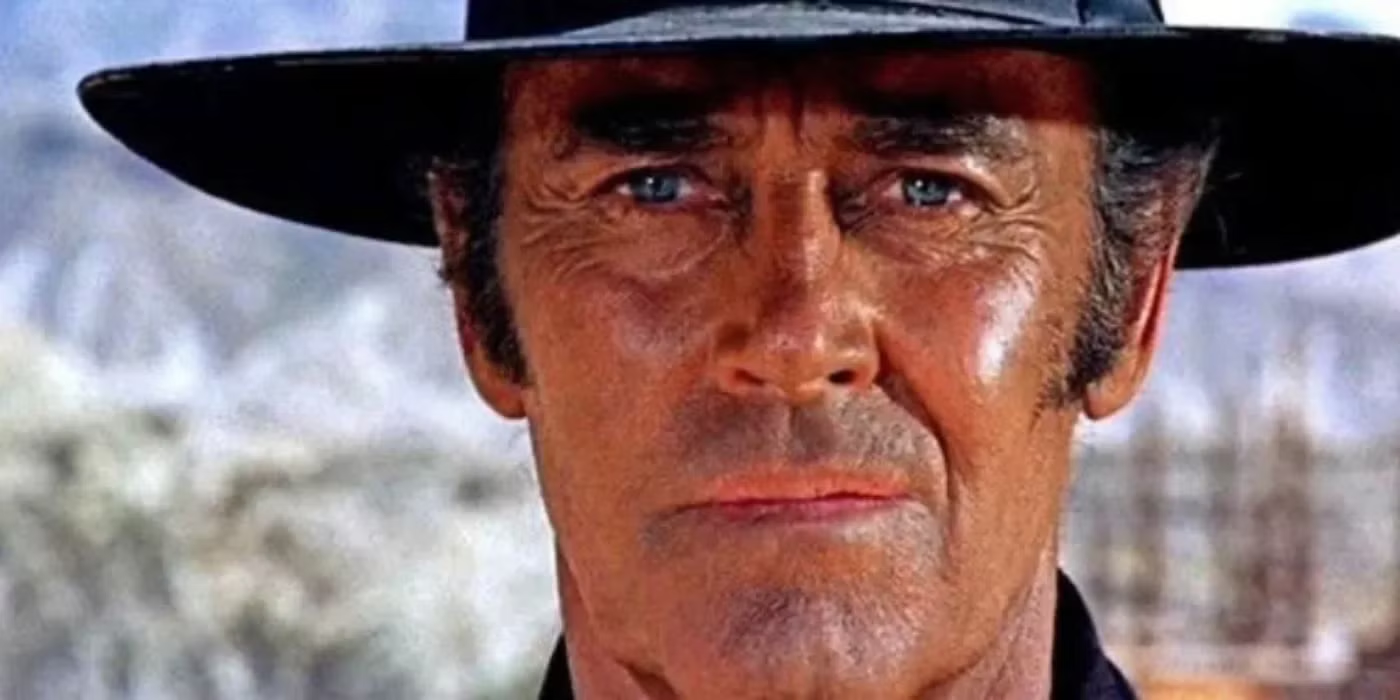
Even the production is filled with unforgettable stories. Leone shocked audiences by casting Henry Fonda, one of Hollywood’s most beloved heroes, as a ruthless child-killing villain. Fonda tried to hide behind brown contact lenses and a mustache, but Leone insisted he remove both. He wanted audiences to see those famous blue eyes and feel the shock.
Then there is the famous fly in the opening sequence. When the local flies disappeared during filming, the crew reportedly resorted to rubbing watermelon juice on an actor’s face to lure insects back into the shot.
And in one of cinema’s darkest behind-the-scenes tragedies, Canadian actor Al Mulock, who appears as one of the rugged, unshaven gunmen in the opening scene, died by suicide during production while still wearing his costume.
Nearly sixty years later, Once Upon a Time in the West remains one of the greatest Westerns ever made because it transcends the genre entirely. It is a film about revenge, capitalism, technology, mythology, and the unstoppable march of progress. More importantly, it is proof that sometimes music can do more than accompany a movie.
Sometimes, the music writes the movie first.
Discover more from Sandbox World
Subscribe to get the latest posts sent to your email.