
Part Two: How the Automobile Became Our Digital Living Room
When I finished writing Part One, I thought the story was complete. Then another question started following me home during my evening commute. If our cars have become our second homes, when did they also become our digital living rooms? The more I thought about it, the more I realized that this wasn’t a story about smartphones or social media. It was a story that had been unfolding for more than a hundred years, one new invention at a time.
Have you ever noticed that every major entertainment revolution eventually finds its way into the automobile? It happened with the radio. It happened with eight-track tapes, cassettes, CDs, satellite radio, Bluetooth, streaming music, podcasts, and now content creation. Every time the way we consume media changes, our cars quietly adapt right along with it. Looking back, I don’t think that’s a coincidence. The automobile has always evolved to reflect the way we live.
I grew up with Montreal radio. Like a lot of people, I had my favorite stations and my favorite personalities. They talked about the Canadiens, the weather, traffic on Décarie, local politics, concerts coming to town, and whatever else was happening around the city that day. Those voices became part of my morning routine. Before I’d even had my first coffee, I already knew what was happening around Montreal because someone on the radio had filled me in during the drive. Thousands of us were listening to the same songs, laughing at the same jokes, and complaining about the same traffic, even though we’d never met. There was something comforting about knowing an entire city was sharing the same conversation during the morning commute.
My commute sounds completely different today. One morning, I might be listening to a history podcast from England. The next day, it could be a film discussion from Los Angeles. My drive hasn’t gotten any shorter, but my world has become infinitely bigger. Years ago, my passengers were a couple of familiar Montreal radio hosts. Today, they can be historians, comedians, authors, scientists, or musicians from almost anywhere on the planet. The automobile didn’t just become smarter. It quietly became a passport to ideas.
That change says something interesting about how the media has evolved. We used to gather around the same radio stations and discover the same songs together because our choices were limited. Today, two cars stopped side by side at the same traffic light might be connected to completely different worlds. One driver could be listening to a podcast about space exploration while the other is learning to make homemade pasta or catching up on the latest comic book news. We still share the road, but our journeys have become wonderfully personal.
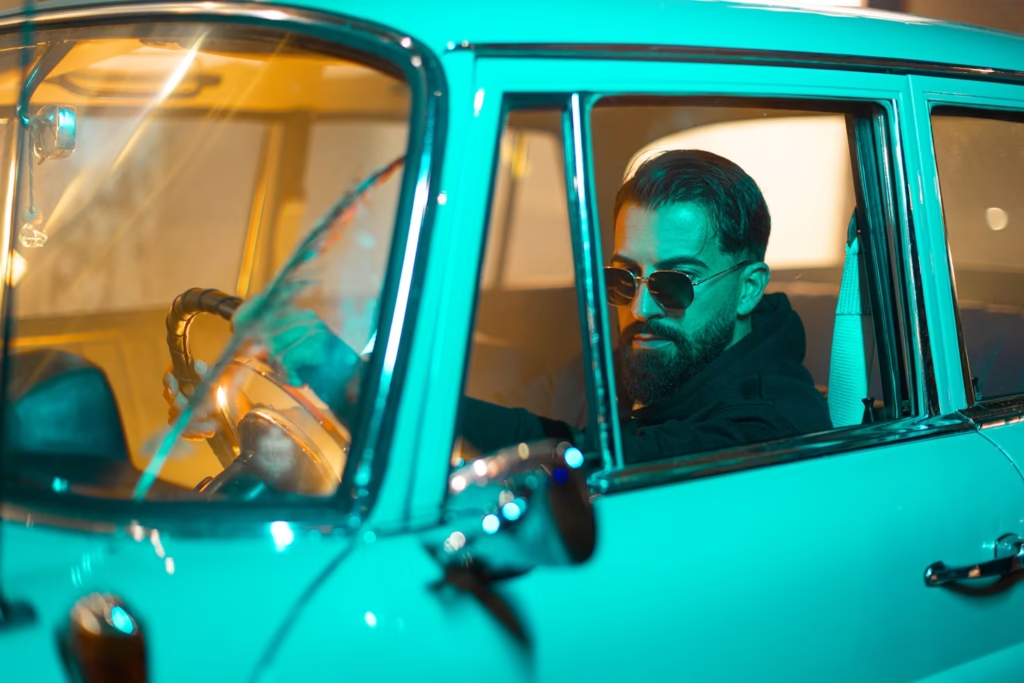
On a personal note, I’ve always believed music sounds better in a car than almost anywhere else. Maybe it’s because the cabin becomes its own little concert hall, or maybe it’s because the rhythm of the tires and the hum of the engine somehow become part of the song. There’s something about driving with your favorite album playing and the scenery rolling past the windows that feels right. The destination almost becomes secondary because, for a little while, the drive itself is part of the performance.
Podcasts create a completely different feeling. Instead of a concert, they feel like company. The best hosts make you forget you’re listening to a recording. It feels as though they’re sitting in the passenger seat, sharing stories, debating ideas, or taking you down some fascinating rabbit hole. I’ve learned about history, psychology, movies, cooking, comics, and places I’ve never visited, all while driving roads I’ve travelled hundreds of times before. It’s funny how the route stays the same while the journey somehow keeps getting bigger.
Of course, having access to millions of songs and thousands of podcasts has created a problem none of us saw coming. I sometimes spend more time deciding what to listen to than actually listening to anything. Remember when the biggest decision before leaving the house was which cassette or CD to bring? If you picked the wrong one, that was your soundtrack until you got home. Today, we have almost the entire history of recorded music sitting in our dashboard, yet somehow many of us still scroll through endless playlists convinced there’s absolutely nothing worth listening to.
Why do so many unforgettable movie scenes happen inside cars? The more I thought about it, the more I realized Hollywood figured this out long before the rest of us. Families argue there. Friends laugh there. Couples fall in love there. Heroes catch their breath there. Detectives solve mysteries there. Screenwriters understand that something changes when two people sit side by side instead of face-to-face. The road has a funny way of lowering our defenses and making conversations feel more honest.
That’s probably why the opening scene from Wayne’s World still works so well. Wayne and Garth weren’t entertaining us because they were singing “Bohemian Rhapsody.” They were entertaining us because every one of us had already staged our own private concert behind the wheel. The joke wasn’t about the car. The joke was that we all recognized ourselves. The same idea shows up in road-trip movies, where the destination is rarely the most memorable part of the story. It’s everything that happens between the departure and the arrival that stays with us.
Television eventually caught on, too. Jerry Seinfeld understood that two comedians driving around and grabbing coffee could produce conversations that felt more genuine than almost any studio interview. Carpool Karaoke borrowed the same idea from a different angle. Watching famous musicians laugh, miss lyrics, and enjoy themselves in traffic reminded us that celebrities are just people once the stage lights disappear. The car wasn’t the attraction. Authenticity was.

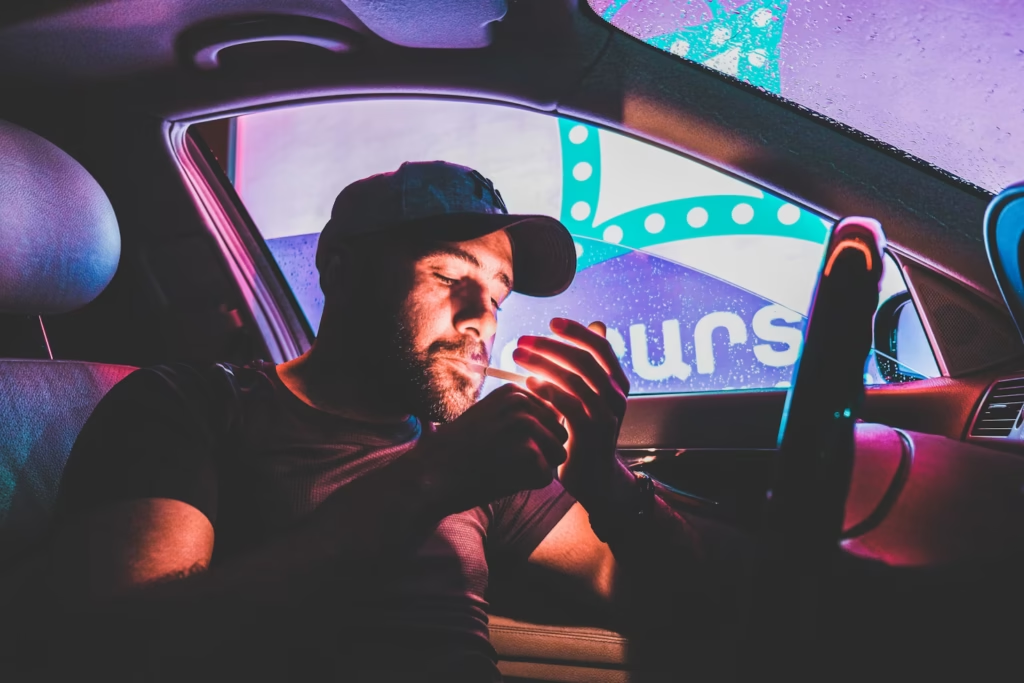
Somewhere along the way, something remarkable happened. Our cars stopped being places where we simply consumed entertainment and became places where we created it. For decades, we climbed into our cars to listen. Today, many of us climb into them to talk. Authors announce new books from the driver’s seat. Musicians preview songs. Small business owners share ideas before heading into the office. Comedians test new material. Content creators turn a quiet parking lot into a recording studio. The dashboard didn’t suddenly become a stage. It had been quietly preparing for that role for generations.
When you stop and think about it, the modern automobile is an incredible piece of technology. It has GPS that reroutes us around traffic, Bluetooth that turns the cabin into a mobile office, voice assistants that answer questions, cameras that watch every angle around the vehicle, sensors that warn us about danger, and software updates that arrive while we sleep. Sometimes I look around and wonder when I stopped driving a car and started driving a computer with four wheels. At the rate we’re going, my next car is probably going to ask me to accept the terms and conditions before it lets me leave the driveway.
For all that technology, though, some things never seem to change. My car can remind me that my tire pressure is low, suggest a faster route, warn me if someone is in my blind spot, and practically park itself. Somehow, it still can’t convince the driver in front of me that the light has been green for the last five seconds. I suppose even artificial intelligence has decided that some traffic problems are simply beyond its capabilities.
I do have one other pet peeve. I can’t be the only person who’s noticed that some drivers treat speakerphone conversations like public broadcasts. Before they’ve even said hello, the rest of us have heard the phone dial, the ringtone, and enough of the conversation to know where they’re going for dinner and what they think about their boss. Bluetooth is a wonderful invention, but “hands-free” was never supposed to mean “the entire parking lot gets to listen.”
The more I think about it, the more I realize that the automobile means something different to everyone. For some people, it’s simply transportation. For others, it’s a classroom, a concert hall, a mobile office, a recording studio, or the place where tomorrow’s best idea suddenly appears. Sadly, for others, it’s even a temporary home. Few inventions have quietly become so many different things to so many different people, and perhaps that’s why the automobile continues to evolve alongside us.
Maybe that’s the biggest lesson I took away from writing this series. In Part One, we explored the private lives we live inside our cars. What I didn’t appreciate until afterward was that we were never the only audience. For more than a century, broadcasters, musicians, filmmakers, television producers, podcasters, and now content creators have all recognized the same thing. Some of our best conversations, our biggest ideas, our favorite songs, and our most memorable moments happen somewhere behind the wheel.
We often think the automobile changed because technology demanded it. I think the opposite is true. The automobile changed because we did. Every generation found a new way to fill that small space with stories, music, laughter, ideas, and connection. Our cars didn’t become digital living rooms overnight. They earned that title one innovation, one conversation, and one generation at a time.
Maybe that’s why our cars have remained so important for more than a century. They never stopped adapting because we never stopped changing. The technology evolved, the entertainment evolved, and somehow the automobile evolved with both. Long before we called them digital living rooms, they were already helping us connect with the people, the stories, and the ideas that mattered most. That’s a remarkable legacy for something most of us still think of as simply a way to get from one place to another.
Read Part One: How the Automobile Became Our Second Home
Discover more from Sandbox World
Subscribe to get the latest posts sent to your email.