
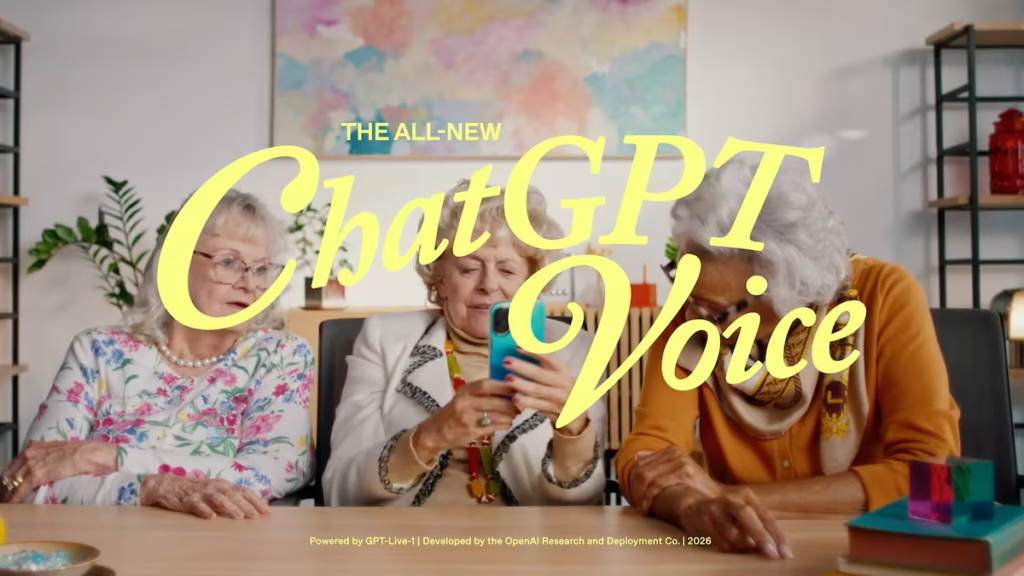
I came across a really cool video demonstrating the latest AI voice technology, and it immediately grabbed my attention. I expected to be impressed by how natural the voice sounded. Instead, I found myself paying more attention to the people using it.
The video featured grandmothers planning vacations, getting help with knitting, and simply having everyday conversations with an AI assistant. There were no flashing graphics, no dramatic music, and no promises about changing the world. It was refreshingly ordinary, and that’s exactly what made it so remarkable. For the first time, I realized this technology wasn’t being presented as a futuristic marvel. It was being welcomed into everyday life. That was the genius of the video. It wasn’t really selling artificial intelligence. It was quietly showing that it no longer belongs only to programmers and early adopters. It belongs to everyone.
Watching those grandmothers also made me smile. For years, we’ve joked about the “cat lady.” Now we may be entering the age of the chatty AI grandmother. Then again, can you really blame them? Families are busier than ever, children don’t always live nearby, and life has a way of getting in the way of regular visits. If an AI companion can answer questions, help plan a vacation, or simply carry on a conversation over a cup of coffee, maybe that’s not something to laugh at. The irony, of course, is that while Grandma is chatting with AI, her kids might be too busy talking to their own digital assistants. It’s a funny image, but it also says something about the world we’re creating.
As I watched, my mind started doing what it always does. One interesting idea led to another, and before long, I wasn’t just thinking about a new AI voice. I was thinking about science fiction, pop culture, and how quickly we’ve become comfortable talking to machines as though they’re old friends.
The newest generation of voice assistants feels very different from what we experienced only a few years ago. Conversations flow naturally, interruptions don’t throw them off, and the back-and-forth feels less like giving commands to a computer and more like talking with another person. It reminded me of the movie Her, where the technology wasn’t impressive because it was intelligent. It was impressive because it felt personal. For a moment, it felt as though science fiction had quietly caught up with reality.
Naturally, the internet wasted no time having fun with it. People started asking long, complicated questions, only to interrupt the response halfway through just to see what would happen. Somewhere, I picture an exhausted digital assistant finishing another long day, wondering why humans insist on turning everything into a game. Honestly, we’re terrible sometimes.
Watching those videos also reminded me how long science fiction has been preparing us for this moment. We grew up with HAL 9000, KITT, Data, Rosie the Robot, Johnny 5, JARVIS, The Matrix, and Black Mirror. Those stories warned us that artificial intelligence would either save humanity or destroy it. I don’t remember any of them predicting that one of its most popular jobs would be helping someone with a knitting pattern.
That contrast made me smile because HAL refused to open the pod bay doors, whereas today’s digital assistants help people plan vacations, organize grocery lists, settle trivia arguments, and explain recipes. The future didn’t arrive with laser beams and flying cars. It arrived quietly through conversations that feel so natural, we’re already starting to take them for granted.
That’s when the bigger question popped into my head. What happens when this technology doesn’t just answer our questions but gradually learns who we are? The more we use it, the more it recognizes our interests, our writing style, our favorite books, our sense of humor, and the little habits that make each of us unique. Now and then, it finishes a thought in a way that makes me stop and think, “That sounds like something I would have said.”
I’ll admit, that’s happened to me more than once. There have been moments where I’ve laughed because the response was almost exactly what I was thinking. That’s when it stopped feeling like software and started feeling like a genuinely interesting conversation. It’s both fascinating and a little unsettling because the better it gets to know us, the more it begins to sound like us.
Once that idea settled in, my imagination took over. What if future generations could do more than inherit our photographs, journals, and home movies? What if they could actually have a conversation with us? Imagine a great-grandchild asking, “What did Grandpa think about the world?” and hearing stories, opinions, and memories instead of simply reading words on a page. That’s both exciting and just unsettling enough to make for a great science fiction story.
I began to reflect on the individuals we’ve admired for decades. We have documented countless interviews, books, concerts, speeches, podcasts, and films featuring remarkable people. We can preserve all of that knowledge in ways we’ve never imagined before. Just imagine asking William Shatner about Star Trek, Ozzy Osbourne about music, or Clint Eastwood about filmmaking. Instead of simply preserving history, we may eventually find ourselves interacting with it. That no longer feels like fantasy. It feels like a future that’s slowly coming into focus.
Then my thoughts returned to everyday life because that’s where every great technology eventually ends up. We already walk past people wearing Bluetooth earbuds and have no idea whether they’re talking to a friend, a coworker, or a family member. It isn’t hard to imagine a future where we also won’t know whether they’re talking to another person or to their own digital assistant, and nobody will think twice about it.
Every technological revolution seems to follow the same path. At first, it feels like science fiction. Then it feels a little awkward. Eventually, it becomes so ordinary that we wonder how we ever lived without it. I don’t think the biggest change will be the technology itself. I think the biggest change will be the day we stop talking about AI altogether because it has simply become another part of everyday life, much like the internet or electricity.
Of course, my inner science fiction fan can’t help wondering where all of this is heading. One minute we’re asking these new tools to help organize our day, and the next we’re wondering if they can become a reflection of ourselves. Somewhere, the Cylons are probably looking down and thinking, “Finally… they’re catching up.”
Maybe that’s why Black Mirror feels less like fiction every year. The technology itself is fascinating, but the bigger story is how quickly we’ve adapted to it. We ask it for advice, bounce ideas off it, thank it when it helps us, and sometimes even apologize when we interrupt it. That says as much about us as it does about the technology.
Thinking back to that video, I realize I don’t remember the technical specifications. I don’t remember the features or the demonstrations. I remember the grandmothers. They weren’t amazed by artificial intelligence. They were simply using a new tool to make life a little easier and, perhaps, a little less lonely. Maybe that’s the future after all. Not a world where machines replace people, but one where they quietly help us spend a little more time being human. If that happens, perhaps the greatest achievement of AI won’t be that it learned to talk like us. It will remind us how important conversation has always been.
Discover more from Sandbox World
Subscribe to get the latest posts sent to your email.