

Out of the Sandbox
Tony’s Personal Opinions
Now and then, I wander out of the sandbox to share a completely personal opinion. You may agree with me. You may think I have lost my mind. Either way, these are simply my observations, backed by a little research and a healthy dose of curiosity.
Why I Hate Rhubarb
There are not many foods I truly dislike. My mother has spent years warning my wife that I am a picky eater, and she is not entirely wrong. As a kid, if something landed on my plate that looked suspicious, I treated it like a customs officer inspecting luggage. I was not trying to be difficult. I simply believed dinner deserved a quality-control department.
Looking back, I should probably thank my mother for one thing: she never tried to serve me rhubarb. If she had, I might still be sitting at the dinner table waiting to be excused. Ironically, she loves kale, another food I have never understood. Remember when kale suddenly became everyone’s favorite superfood? Restaurants were putting it in salads, smoothies, sandwiches, and even chips. I spent that entire trend wondering who tasted kale first and thought, “Yes, let’s make more of this.”
After this week’s trip to the grocery store, I finally decided it was time to say something about another food that has puzzled me for years: rhubarb.
I walked into the bakery section with one simple mission: buy a cherry pie. The plan was already in place. Warm it in the microwave just long enough to heat the filling without turning the crust into a soggy mess, then top it with several generous scoops of vanilla ice cream and watch it slowly melt into the warm cherries. It is one of life’s simple pleasures.

There was just one problem. There were no cherry pies. For a brief moment, I considered asking an employee if they had one hiding in the back. Then I remembered this is a grocery store, not a speakeasy.
Instead, the shelves were overflowing with apple-rhubarb pies. Why? Who decided apples needed a lifelong partner in rhubarb? Apples are sweet, comforting, and dependable. Rhubarb barges into the relationship like the relative nobody invited to Thanksgiving dinner. It’s a pairing that has never made sense to me.
I am not one to climb onto a soapbox. Do they even make those anymore? I know the sandbox a lot better, and since I am not tall enough to see over the crowd anyway, I will simply ask one question: why does rhubarb keep disguising itself as other fruits?
You rarely see a pie proudly announcing, “Here is rhubarb. Enjoy!” Instead, it sneaks into apple pie, strawberry pie, and even gooseberry recipes. Cook it the right way and it can even resemble celery. Rhubarb is basically the food world’s master of disguise. Or vegetable, technically. See? It cannot even make up its own mind.
Despite my feelings, rhubarb has an incredibly loyal fan club. It is celebrated throughout Germany, the Nordic countries, Canada, and parts of the United States, particularly the Pacific Northwest and the Midwest. No country, however, embraces it quite like the United Kingdom.
At first, I wondered if Britain’s affection for rhubarb had something to do with the Second World War. It turns out there is some truth to that, although the story began much earlier. Rhubarb became popular in Britain during the eighteenth and nineteenth centuries after sugar became affordable enough to tame its famously tart flavor.
When the Second World War brought food rationing, imported fruit became scarce and the British government launched its famous “Dig for Victory” campaign, urging families to transform backyards and millions of allotment gardens into productive vegetable plots. Rhubarb thrived in Britain’s cool climate, making it a dependable ingredient for pies, crumbles, and jams when other fruits were difficult to find. Kale, already a staple in Britain, became even more important because it was nutritious, inexpensive, hardy, and easy to grow during the food shortages.
Suddenly, my mother’s love of kale and Britain’s love affair with rhubarb started to make a little more sense. It is amazing how a little history can change your perspective. Five minutes earlier, I was blaming the British for apple-rhubarb pie. Then I learned they were simply making the best of incredibly difficult circumstances. I still do not want a slice, but at least now I understand why they do.
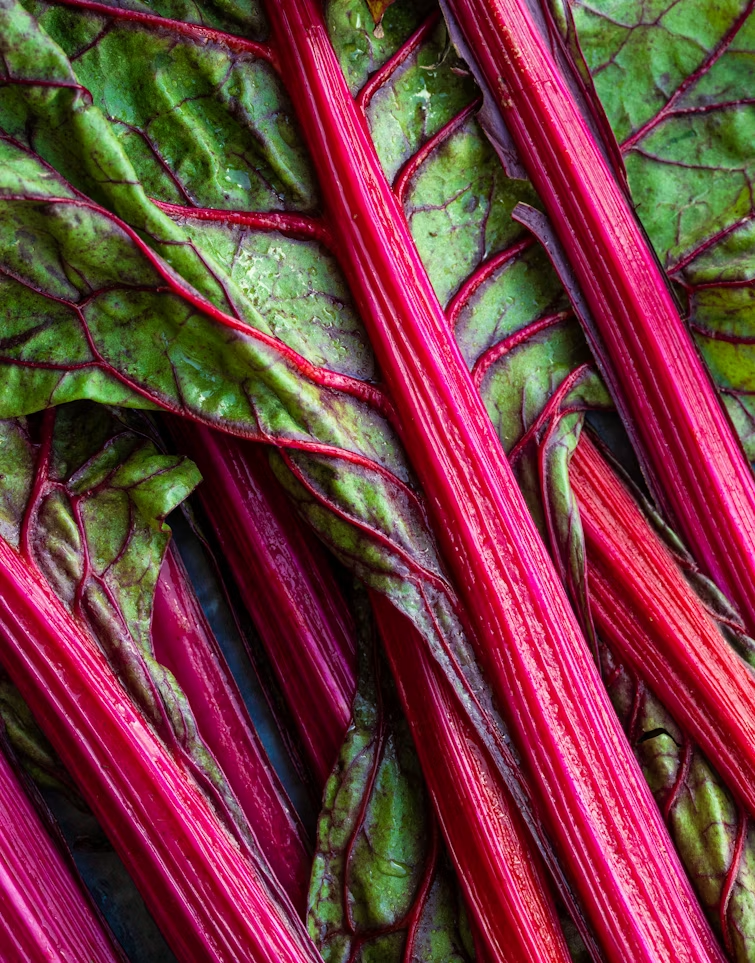
The British even took rhubarb cultivation to another level in Yorkshire’s famous Rhubarb Triangle. There, the plants are grown in heated sheds kept in complete darkness, and workers harvest the stalks by candlelight so photosynthesis does not toughen them. The result is an unusually tender, bright pink stalk destined for crumbles, pies, and generous helpings of hot custard.
I have to respect that level of commitment. Imagine explaining that job at a party.
“So, what do you do for a living?”
“I harvest rhubarb by candlelight.”
It sounds less like farming and more like the opening scene of a horror movie. After all that effort, I still wish they had grown more cherry trees.
Food writer and pastry chef David Lebovitz once shared a story that perfectly captured my feelings. A cookbook author appeared on a live morning television show to demonstrate a fresh rhubarb dessert. The moment the cameras started rolling, the host blurted out, “Rhubarb? I hate rhubarb!” For the next several minutes, the poor guest quietly assembled the pie while the host launched into a full-blown anti-rhubarb rant. I have never met that host, but for those few minutes, we were kindred spirits.
Even in Britain, where rhubarb enjoys celebrity status, it carries some emotional baggage. Many people remember school cafeteria desserts featuring lukewarm stewed rhubarb covered in thick custard. Comedians have even used rhubarb as shorthand for old-fashioned desserts that nobody was excited to see.
If you have never eaten raw rhubarb, let me save you the trouble. It looks like celery that spent a little too much time blushing in the sun, but one bite delivers enough sourness to make your face invent entirely new expressions.
Rhubarb is so divisive that philosophers actually use it as the textbook example of subjective disagreement. One person says it is delicious. Another says it is awful. Neither person is objectively wrong because taste is personal. Finally, a debate where I know I am on the right side.
If you love rhubarb, more power to you. Eat the pie. Make the crumble. Pour on the custard. Harvest it by candlelight if that is your thing. Just stop hiding it inside perfectly innocent apple pies.
I walked into the grocery store craving a cherry pie and somehow walked out with an entire opinion column about a vegetable I cannot stand. In my book, that’s rhubarb’s greatest crime.
Back to the sandbox.
Discover more from Sandbox World
Subscribe to get the latest posts sent to your email.