

In his piece for Rolling Stone, Garry Trudeau explains why Snoopy has always stood out as more than just a cartoon dog. To Trudeau, Snoopy represents the ultimate American dreamer, a character who constantly escapes ordinary life through imagination, fantasy, and pure determination. Even when his adventures crash back to reality, Snoopy never stops reinventing himself. That endless optimism and ability to transcend his surroundings is what Trudeau calls part of the character’s magic.
There is a creative thread that quietly connects Garry Trudeau and Charles Schulz, and it runs straight through the world of enduring comic-strip icons like Snoopy. In his reflections, Trudeau has often pointed out that his own slacker character, Zonker Harris, functions as a kind of Doonesbury-era equivalent to Snoopy. Both characters share that rare “forever young” quality; they do not age, they do not fully evolve into adulthood, and they exist slightly outside the pressure of the real world. That timeless quality is what allows them to remain cultural anchors of escapism.
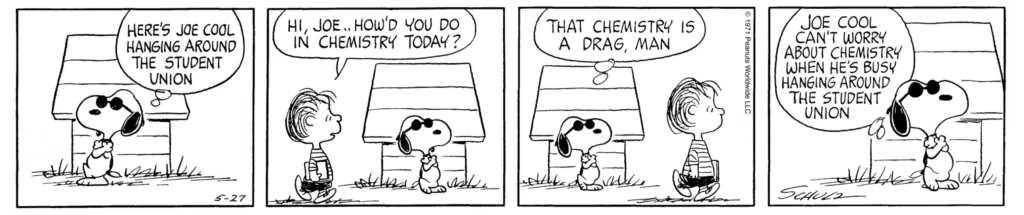
The connection becomes even clearer when you look at Snoopy himself. He is not just a comic relief character; he is a full psychological universe wrapped in a beagle. Schulz gave him autonomy, imagination, and a private mythology that constantly expands beyond the strip’s reality. Trudeau saw that as revolutionary. It helped shape his own approach to character writing, where figures like Zonker could drift between satire and surreal detachment without ever fully breaking the world they inhabited.
What Trudeau also finds fascinating is Snoopy’s independence. Unlike the typical loyal comic-strip dog, Snoopy often behaves more like a cat, completely operating on his own terms. He casually dismisses Charlie Brown as “that round-headed kid” while creating entire fantasy worlds where he becomes everything from the World War I Flying Ace to a famous novelist. Snoopy’s imagination gave him a kind of freedom rarely seen in comic-strip characters at the time.
It was this haiku-perfect character humor that dazzled Schulz’s peers. In Snoopy, he had created an American archetype – the persistent dreamer for whom nothing seems out of reach, even when it usually is. In the process, Snoopy took on far more agency than your typical, needy dog, becoming much more like, well, a cat. Aloof, autonomous, ever disdainful of an owner he called “that round-headed kid,” Snoopy would typically preannounce the arrival of a new persona – “Here’s the world-famous …” – and then let his imagination take over, come what may. He represented, for me anyway, perfect freedom, and in my early work, I borrowed this device of self-narration. My characters often declared who they thought they were, no matter how at variance it was with who they revealed themselves to be. The laughs lay in the contradictions.
Trudeau admits Snoopy had a direct influence on his own work in Doonesbury. He especially admired the way Snoopy would announce his alter egos with lines like “Here’s the world-famous…” before launching into another fantasy. Trudeau borrowed that same self-narration technique for his own characters, allowing them to declare who they believed themselves to be, while the humor often came from the reality of who they actually turned out to be.
You can read Trudeau’s full essay on the Rolling Stone website.

If this article made you think, brought back a memory, or made you see something differently, I’d love to hear from you. Send me an email at sandboxworld@gmail.com. I read every message personally and, with your permission, may feature your thoughts in a future article because the best stories are the ones we share.
Discover more from Sandbox World
Subscribe to get the latest posts sent to your email.