


Part One of a three-part Sandbox World series exploring the practical questions comic books never stop to ask.
The Business of Batman
Ask almost anyone what Batman’s greatest superpower is, and you’ll probably hear the same answer. It isn’t his detective skills, his discipline, or his willingness to fight criminals who are stronger than he is. Most people point to Bruce Wayne’s fortune because it seems to answer every practical question. How did Batman build the Batmobile? Bruce Wayne paid for it. How did he create the Batcave? Bruce Wayne paid for it. How does he continue inventing incredible gadgets year after year? Bruce Wayne paid for them. The explanation feels so obvious that most of us never question it.
The more I thought about that answer, though, the more it started to fall apart. Money explains how Batman can afford extraordinary technology, but it doesn’t explain how he keeps any of it hidden. Bruce Wayne doesn’t live in a world where accountants disappear, suppliers never send invoices, governments ignore regulations, and shareholders stop asking questions. If anything, being one of Gotham’s wealthiest businessmen should mean every major purchase receives even more attention than everyone else’s.
That’s when I stopped asking how Batman paid for the Batmobile and started asking who approved it. Somebody had to authorize the budget. Somebody had to negotiate supplier contracts. Somebody had to explain why Wayne Enterprises suddenly needed aerospace alloys, military-grade electronics, reinforced armour, advanced propulsion systems, and enough titanium to build something that definitely wasn’t going to be parked outside company headquarters. Comic books never show us that part of Batman’s world because they’re not supposed to, but once the question entered my head, it refused to leave.

We all love the moment when the tarp comes off a brand-new Batmobile or Lucius Fox unveils another impossible invention. That’s the exciting part of the story because it reminds us why Batman has always stood apart from other superheroes. What we never see are the months leading up to that moment, when engineers are drawing blueprints, buyers are sourcing materials, technicians are testing prototypes, accountants are opening project codes, and someone on a loading dock is signing for another shipment of titanium without realizing they’re helping build one of the most famous vehicles in comic book history.
The Batmobile doesn’t begin life in the Batcave. It begins as a project, and that project follows the same path as every other major initiative inside a multinational corporation. An engineer sketches the first concept. Procurement starts comparing suppliers. Manufacturing estimates production costs. Finance assigns another confidential budget. Somewhere inside Wayne Enterprises, people spend months doing completely ordinary jobs that slowly become part of something extraordinary. None of them believes they’re building Batman’s newest vehicle. To them, it’s simply another classified research project with an aggressive deadline and a mountain of paperwork.

That’s the moment Batman stopped looking like a superhero to me and started looking like the world’s most expensive corporate initiative. Instead of picturing rooftop chases, I found myself imagining conference rooms. I could almost see executives studying budget reports. At the same time, someone quietly pointed out that research spending had increased again, prototype development was over budget again, and another confidential transportation project required additional funding before the quarter ended.
That’s where Lucius Fox becomes one of the most fascinating people in Gotham because most fans think of him as Batman’s gadget builder, but I think that’s only half the job. Designing the Batmobile is an engineering challenge. Explaining the Batmobile to a board of directors without revealing what it’s actually for might be an even greater accomplishment. It takes intelligence to build remarkable technology, but it takes extraordinary leadership to convince experienced executives that another expensive confidential project makes perfect business sense.
I can almost hear the discussion unfolding around the boardroom table. Someone from Finance politely asks why another prototype requires reinforced ceramic armour and experimental propulsion systems. Procurement points out that Wayne Enterprises has quietly become one of the country’s largest buyers of aerospace-grade titanium. Legal reminds everyone that the project remains protected under strict confidentiality agreements. Before anyone grows uncomfortable, Lucius calmly explains that the research has enormous commercial potential, that the technology will benefit future products, and that secrecy is essential to protecting the company’s competitive advantage. The board members exchange a few glances, nod their approval, and move on to the next agenda item because Lucius Fox has earned something more valuable than money. He’s earned their trust.

The more I thought about Wayne Enterprises, the more I realized money doesn’t protect Batman. People do. Engineers honour confidentiality agreements. Buyers negotiate contracts without asking unnecessary questions. Executives trust the people leading sensitive projects. Suppliers deliver exactly what they’re asked to deliver. Every employee performs one small part of the job, and together they create something almost none of them fully understand.
Then I started thinking about the accountants, and that’s when the whole idea became impossible to ignore. Somewhere inside Wayne Enterprises, an accountant opens another quarterly report and notices another confidential research project with unusually high material costs. Reinforced armour. Experimental communications systems. Aerospace components. Industrial quantities of grappling cable. Nothing on the paperwork says “Batman,” yet the numbers tell a story that becomes stranger every year. The accountant reviews the figures, checks the supporting documentation, confirms that all approvals are in place, and quietly moves on to the next file because everything appears to be exactly as it should be.
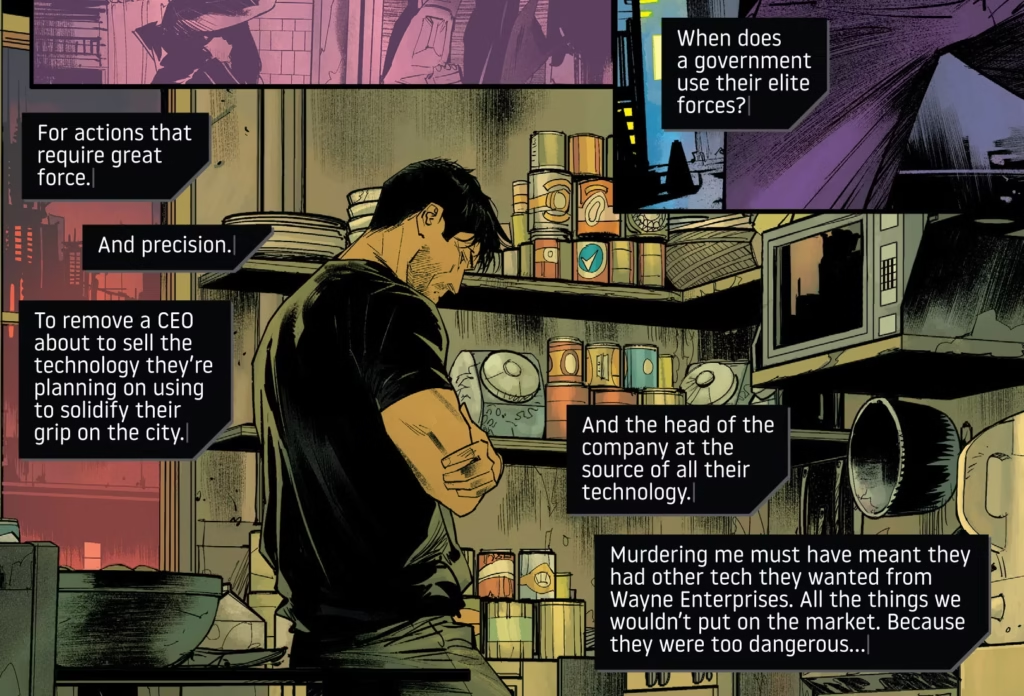
I’ve become convinced that accountants deserve a comic book of their own because they aren’t chasing the Joker across Gotham or racing through the streets in the Batmobile. They’re balancing budgets, reviewing invoices, and making sure every project satisfies corporate policy. Without ever realizing it, they’re helping protect one of the biggest secrets in comic book history simply by doing their job well. Batman may be the World’s Greatest Detective, but somewhere inside Wayne Enterprises, there’s an accountant who’s remarkably good at knowing when not to investigate any further.
Maybe that’s why I’ve never been completely satisfied with the idea that Batman’s greatest superpower is money. Money can build the Batmobile, but it can’t keep a secret. Money can buy incredible technology, but it can’t inspire loyalty, professionalism, and trust across an entire organization. Those qualities belong to people, and they’re much harder to buy than another prototype vehicle.
As I kept following that thought, another question appeared, and it turned out to be even more interesting than the first. If building Batman requires an entire corporation working quietly behind the scenes, what happens to Gotham after Batman wins? Who rebuilds the bridges, repairs the buildings, replaces the equipment, and keeps the city moving after another long night of chaos? That answer begins with Bruce Wayne, but it doesn’t end there because it leads into something much bigger. It leads into Batman Economics.
- Batman’s Greatest Superpower Isn’t Money. It’s Accounting. (How Batman is funded.)
- Batman Economics. (How Gotham survives.)
- Working at Wayne Enterprises Must Be Exhausting. (The people who unknowingly make Batman possible.)
Discover more from Sandbox World
Subscribe to get the latest posts sent to your email.