


When Neil Armstrong stepped onto the Moon on July 20, 1969, history celebrated one of humanity’s greatest achievements. Nearly 650 million people watched as he took those first careful steps across the lunar surface, proving that what generations had only imagined had finally become reality. Apollo 11 has become the defining image of the Space Age, yet the older I get, the more I wonder if humanity’s journey to the Moon really began nearly twenty years earlier.
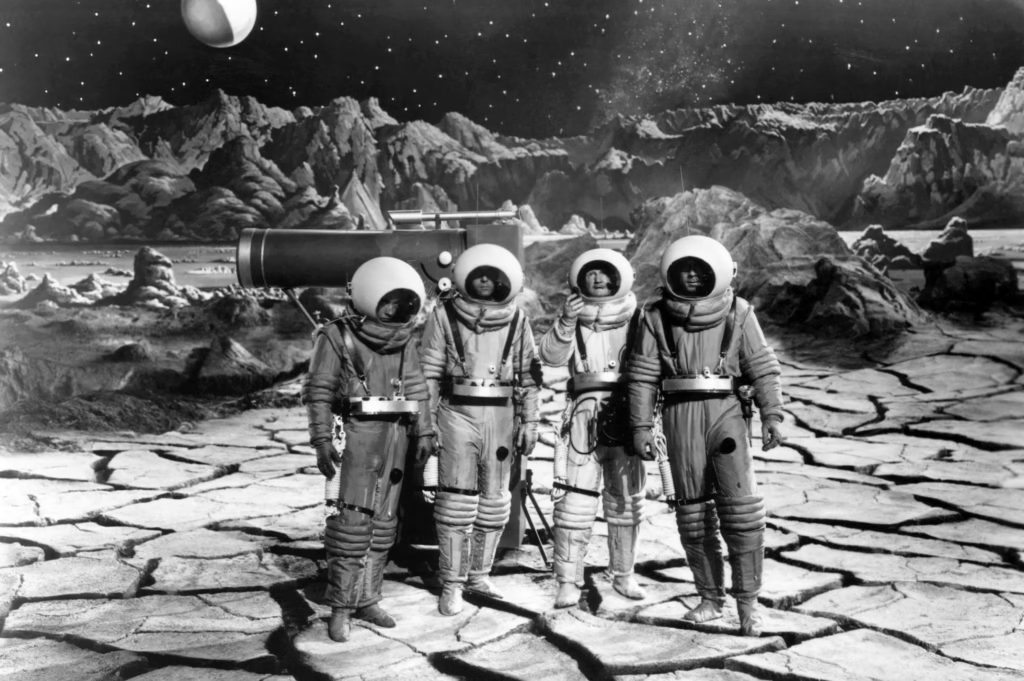
That question first entered my mind while revisiting one of my favourite Tintin adventures, Destination Moon and Explorers on the Moon. Instead of simply enjoying the story, I found myself noticing how grounded it felt. Hergé wasn’t asking readers to believe in magical machines or impossible technology. He treated space travel as an engineering challenge built on science, planning, and determination. Around the same time, producer George Pal and science fiction writer Robert A. Heinlein were bringing audiences a remarkably similar vision with the 1950 film Destination Moon, presenting spaceflight as something that could be achieved through knowledge rather than fantasy.
The more I explored these works, the less interested I became in comparing a comic book and a movie. Instead, I found myself asking a much bigger question. How did Hergé, George Pal, and Robert A. Heinlein, working independently on opposite sides of the Atlantic, arrive at such remarkably similar visions of humanity’s first journey to the Moon? The answer, I believe, has less to do with influence than with history itself.
The year 1950 occupied a unique place in the twentieth century. The Second World War had ended only five years earlier, yet its influence could still be felt everywhere. Europe was rebuilding shattered cities while scientists struggled to understand the extraordinary technological advances that had emerged from the conflict. Radar had transformed warfare, jet aircraft had rewritten aviation, and atomic energy revealed both extraordinary promise and unimaginable destruction. Above all stood the German V-2 rocket, a weapon that demonstrated humanity had finally developed machines capable of reaching the edge of space.

The V-2 represents one of history’s greatest contradictions. Built for destruction, it also became the technological ancestor of the rockets that would eventually carry satellites, probes, and astronauts beyond Earth. Looking back, it almost feels as though history paused after the war and asked humanity a simple question. Would science continue building better weapons, or could it begin building a better future?
I can’t help wondering if that question quietly influenced Hergé, George Pal, and Robert A. Heinlein. Their lives followed different paths, yet all three witnessed how science and technology could transform the world for better or worse. Rather than imagining more powerful weapons or another global conflict, they imagined scientists, engineers, and explorers working together toward a common goal. Their rockets weren’t symbols of conquest. They were symbols of possibility.
That optimism wasn’t built on fantasy. Hergé immersed himself in research, George Pal insisted on scientific credibility, and Heinlein believed that science fiction should treat readers with intelligence instead of dazzling them with impossible inventions. All three trusted reality enough to believe it could inspire wonder on its own.
The deeper I dug, the more convinced I became that this wasn’t really a story about a comic book and a movie. It was the story of three creators responding to the same historical moment and asking the same hopeful question. If humanity had learned to build rockets during the darkest years of the twentieth century, perhaps those same rockets could someday carry us toward something better than war.

The similarities between these works extended far beyond their rockets. George Pal, Robert A. Heinlein, and Hergé all believed that science fiction became more compelling when it respected science itself. Rather than asking audiences to suspend disbelief, they wanted readers and moviegoers to feel that a journey to the Moon might actually happen within their own lifetime.
Heinlein had already established that philosophy through novels aimed at younger readers. Books such as Rocket Ship Galileo encouraged curiosity by treating engineering, mathematics, and responsibility as exciting rather than intimidating. Hergé approached his Moon adventure with the same respect for detail, consulting experts and studying the latest research before putting pen to paper. George Pal carried that realism onto the screen, deliberately rejecting the fantastic clichés that had dominated earlier science fiction films.
Another fascinating connection linked all three creators to the same artist. Long before astronauts photographed the Moon, Chesley Bonestell painted breathtaking lunar landscapes based on the best astronomical knowledge available. George Pal hired Bonestell to help shape the visual world of Destination Moon, while Hergé studied his published artwork as a reference for Tintin’s adventure. Neither creator copied the other. They simply turned to the same artist because they wanted their visions of space to feel believable.
One historical detail perfectly illustrates how closely these projects developed. Hergé originally intended to title his story Destination Moon, but George Pal’s film had already claimed that name. To avoid confusion, Hergé published the French edition as Objectif Lune. Years later, English publishers restored the title Destination Moon, creating the very coincidence he had originally tried to avoid.
The similarities continued inside the stories themselves. Both feature espionage, sabotage, and the struggle to protect valuable rocket technology. At first glance, those plot elements seem designed simply to create suspense, yet they reflected the political climate of the early 1950s. The Cold War had begun, nations were competing for scientific knowledge, and rocket technology had become one of the world’s most valuable strategic assets.

Despite acknowledging those tensions, neither Hergé nor George Pal allowed fear to define the future. Their stories recognized that technology could be dangerous, yet they chose to imagine a world where scientific achievement served exploration rather than destruction. Looking back today, that optimism may be every bit as remarkable as the technical accuracy for which their work is so often remembered.
The more I reflected on these connections, the less interested I became in deciding who predicted the future first. Prediction almost feels like the wrong word. George Pal, Robert A. Heinlein, and Hergé accomplished something much more meaningful. They encouraged audiences to stop asking whether humanity could ever reach the Moon and begin asking what it would take to get there.
As I worked my way through this story, one final thought refused to leave me. George Pal, Robert A. Heinlein, and Hergé weren’t creating these stories for scientists or engineers. They were speaking to children and young adults whose imaginations were still taking shape. Whether they realized it or not, they weren’t simply writing about the future. They were writing to the future.
That realization struck a personal chord because I grew up before the Internet, when curiosity demanded patience. If you wanted to know more about space, you wrote a letter and hoped someone would answer. As a youngster, I remember writing to NASA because I wanted to learn everything I could about rockets, astronauts, and the Moon. Weeks later, an envelope arrived filled with photographs, brochures, and educational material. Looking back, I realize NASA wasn’t simply answering my questions. They were encouraging young people to dream and quietly suggesting that one day they might help shape that future.
The Space Age reached far beyond launch pads and laboratories. Comic books imagined tomorrow, movies celebrated scientific discovery, classrooms encouraged curiosity, and toy stores filled their shelves with model rockets. Even popular music embraced the optimism of the era. Space Age pop gave the future its own distinctive soundtrack, reflecting a society that genuinely believed tomorrow would be brighter than today.
The more I reflected on those years, the more convinced I became that the 1950s were humanity’s true launching pad. The decade wasn’t simply preparing rockets for space. It was preparing society to believe that space exploration belonged in the real world. Before astronauts could walk on the Moon, millions of ordinary people first had to accept that such a journey was possible.
When President John F. Kennedy challenged the United States in 1961 to land a man on the Moon before the decade was over, his words inspired a nation already primed to dream. Children who had grown up reading Tintin, watching Destination Moon, and discovering Robert A. Heinlein’s novels were now entering universities, engineering schools, and scientific careers. A youngster who watched George Pal’s film in 1950 would have been approaching thirty when Apollo 11 landed in 1969. The timing is difficult to ignore.
I’m not suggesting that Hergé, George Pal, Robert A. Heinlein, or even NASA alone created the generation that made Apollo possible because history is never that simple. I do believe they helped create an atmosphere where curiosity was celebrated, science was admired, and the future felt attainable. They transformed the Moon from a distant object hanging in the night sky into a destination that young people could realistically imagine reaching within their own lifetime.
When Neil Armstrong stepped onto the Moon, the world celebrated one of humanity’s greatest engineering triumphs. I sometimes wonder if millions of people watching that historic broadcast had already made the journey years earlier through comic books, novels, films, and dreams. Before Apollo 11 left its mark on the lunar surface, George Pal, Robert A. Heinlein, and Hergé had already left a different kind of footprint. They reminded a generation that the future belongs to those who first dare to imagine it.
Discover more from Sandbox World
Subscribe to get the latest posts sent to your email.