

I’ve always been fascinated by maps, not just the geography but the business of naming things. Who comes up with these names? How does a town, river, or mountain get its identity? Some names are wonderfully imaginative, others downright silly, and a few make you wonder whether whoever named them had simply run out of ideas. Surely there comes a point when originality becomes a challenge. I imagine there’s a committee somewhere that eventually settles for Pleasant Valley, New Hope or, when all else fails, something involving a creek.
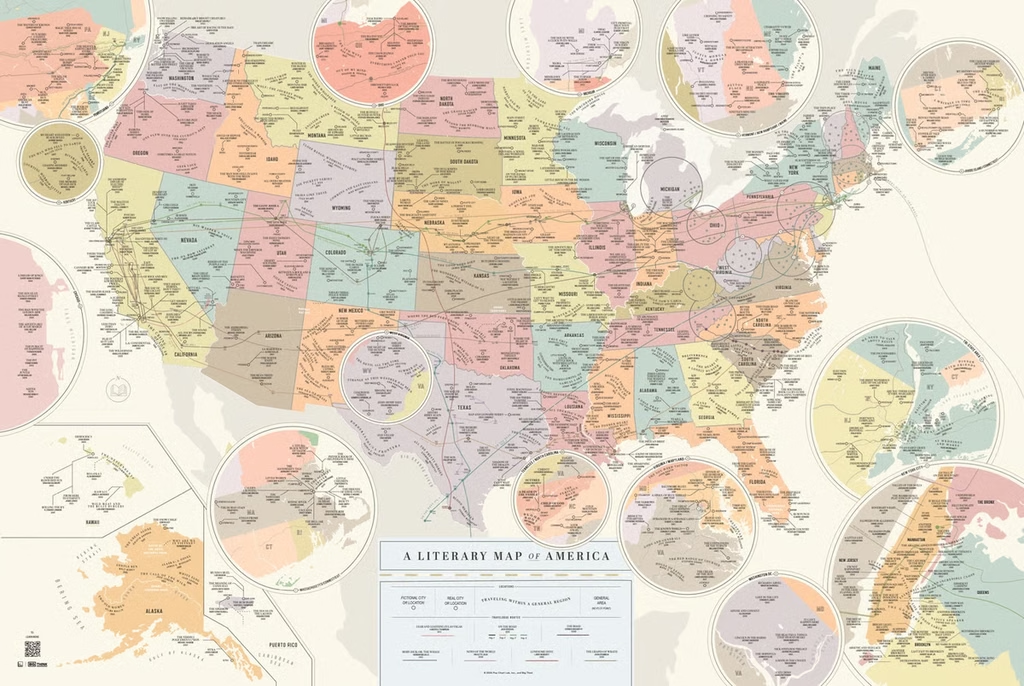
That’s probably why I have a soft spot for A Literary Map of America, a collaboration between Big Think and Pop Chart. It’s an ambitious illustration featuring more than 400 literary landmarks and routes, including the real and imaginary settings of books such as Sleepy Hollow, Lake Wobegon, Brokeback Mountain and F. Scott Fitzgerald’s East Egg and West Egg. Some are actual places, others exist only in the imagination, but all have found a permanent address in American literature.
There’s something wonderful about trying to squeeze an entire country’s literary imagination onto one piece of paper. You can imagine the hours of research and debate involved in deciding where everything belongs. Naturally, the purists will have their say. Just as there are book snobs, there must be map snobs. Somewhere, someone is measuring the precise distance between a fictional town and its supposed location, armed with a ruler and a very strong opinion.
Writing for Big Think, Frank Jacobs takes a closer look at the imaginary geography and raises an interesting point: sometimes writers don’t simply describe a place; they change how we see it.
Think about Maine and Stephen King’s horror stories. It’s difficult to look at a quiet stretch of woodland without wondering whether something unpleasant might be lurking behind the trees. Mark Twain gives us a particular way of seeing the Mississippi, while William Faulkner helped shape the literary image of the American South. The landscape remains the same, but the stories give it another identity.
Of course, a project this ambitious is bound to attract criticism. Readers have pointed out alleged misplaced locations, misspelled titles and favourite novels that didn’t make the cut. Steel Magnolias, Old Yeller and East of Eden have all been mentioned in discussions about the map’s accuracy. There will always be someone convinced their favourite book deserves a place on it. You can’t please everybody, particularly when hundreds of literary works are involved.
In his book Landmarks, English nature writer Robert Macfarlane explores a similar idea: powerful writing can change how we experience a landscape. We see the Suffolk coast through W.G. Sebald, the Mississippi through Mark Twain and the American South through William Faulkner. The books become part of the scenery, even when we’re nowhere near a library.
One thing I’d love to see is a Google Maps version of this project. Imagine clicking on these literary locations, zooming in, exploring the neighbourhood and perhaps even taking a virtual drive through the settings of your favourite books. You could go from the real streets of New York to the imaginary corners of Lake Wobegon without ever leaving your desk. You might even be able to get directions, although I suspect finding the quickest route to some fictional destinations could prove a challenge. Google, if you’re listening, here’s a project worth putting on the map!
Perhaps that’s the real magic of literature. A good book gives you characters to remember, but a great one leaves you with places you can never quite see the same way again.
And the best part? You don’t even need a GPS.
The map and further reading
A Literary Map of America – Pop Chart
American Literature, Charted in One Monumental Map – Frank Jacobs, Big Think
Landmarks – Robert Macfarlane
Discover more from Sandbox World
Subscribe to get the latest posts sent to your email.