

Step into the glitz, glamour, and dark allure of the Roaring Twenties with The Wild Party, a thrilling musical running at New York City Center from March 18–29, 2026. From the first note of Michael John LaChiusa’s jazzy, electrifying score to the unforgettable performances by Jasmine Amy Rogers as Queenie and Adrienne Warren as Kate, this revival pulls you straight into a decadent 1920s party that quickly spins out of control. As the night unfolds, chaos, scandal, and tragedy emerge, perfectly capturing the raw energy, moral ambiguity, and intoxicating excess of the Jazz Age. Attending this production is not just seeing a musical; it’s stepping into a world of glittering danger, forbidden desire, and unforgettable drama.
The musical brings to life Joseph Moncure March’s 1928 narrative poem, The Wild Party, which is approaching its 100th anniversary. For decades, the poem remained a hidden gem, its raunchy, sexually charged content leading to a notorious ban in Boston and limiting its early circulation. Yet despite early censorship, March’s story has never lost its edge or its allure. Over the years, it has resurfaced again and again in popular culture, whether through illustrated editions, theatrical revivals, or hit musical adaptations, proving that the poem’s high-stakes, decadent world continues to captivate audiences nearly a century later. Experiencing the musical today is a chance to witness that enduring allure firsthand, immersing yourself in a story that is as daring, wild, and unforgettable as the Jazz Age itself.

Originally released in a limited edition of just 750 copies by a small Chicago publisher, March’s work was largely overlooked by mainstream literary critics, existing instead as a cult classic. Its reputation was revitalized in 1999 with a new illustrated edition by Art Spiegelman, creator of MAUS, and later gained theatrical prominence with two competing musical adaptations in 2000, emphasizing the poem’s dramatic potential over its literary stature.
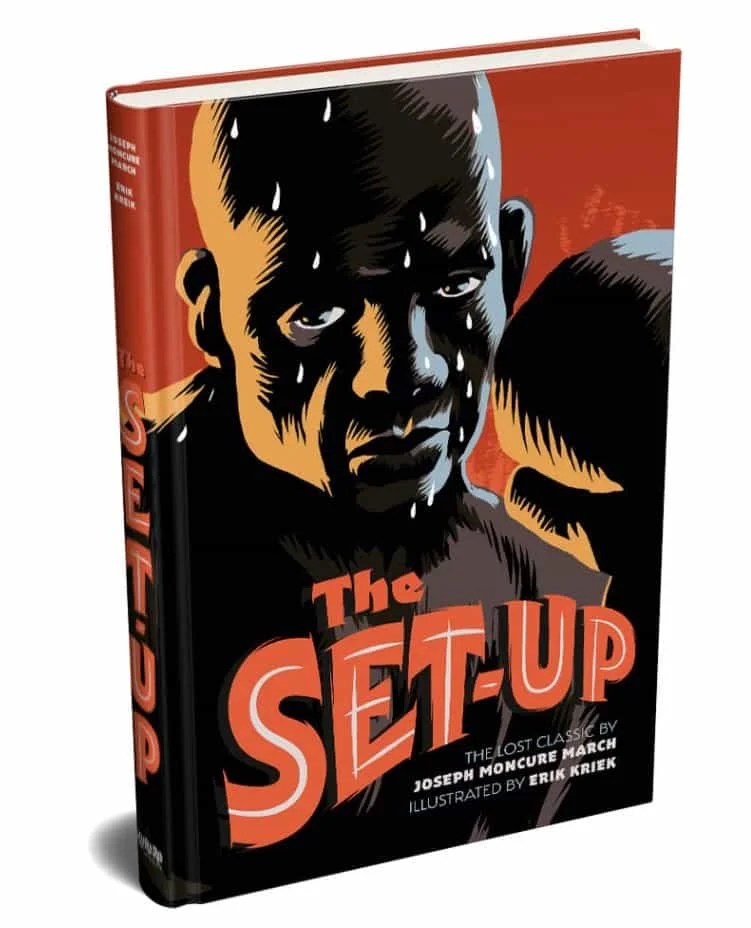
March’s technical mastery and gritty style shine through both The Wild Party and his other famous narrative poem, The Set-Up. While some traditionalists dismissed his work as “doggerel,” modern and historical critics alike recognize him as a master of the hard-boiled, rhythmic American aesthetic. His poems are celebrated for their ability to evoke seedy, transgressive characters, sharp social commentary, and visceral energy. The Set-Up, in particular, is noted for its raw portrayal of underground boxing and racial perception, highlighting March’s unflinching engagement with the darker sides of American life.
Both of Joseph Moncure March’s landmark poems later inspired film adaptations, though their success varied widely. The Set-Up (1949), directed by Robert Wise, is widely celebrated as one of the greatest boxing films ever made and a standout in classic film noir cinema. Critics praised its gritty storytelling, taut pacing, and powerful performances by Robert Ryan and Audrey Totter, capturing the harsh realities of the boxing world. However, the film controversially cast a white actor in the lead role, which diluted the poem’s original exploration of racial dynamics and the systemic challenges faced by Black athletes. Despite this, the adaptation solidified The Set-Up’s status as a seminal work bridging literary realism and Hollywood noir.
In contrast, The Wild Party (1975), produced by Merchant Ivory Productions and starring James Coco and Raquel Welch, met with more modest results. The film diverged significantly from March’s dark, Jazz-Age narrative, instead loosely dramatizing the Fatty Arbuckle scandal, which critics argued undermined the original poem’s chaotic, decadent spirit. While it failed to achieve major commercial or critical acclaim, The Wild Party’s cinematic adaptation contributed to the poem’s ongoing cultural presence, paving the way for later revivals, illustrated editions, and acclaimed musical versions that would eventually bring March’s wild, Jazz-Age world to a broader audience.
Much of March’s mid-century legacy is intertwined with illustrator Steele Savage, whose striking visual style complemented March’s rhythmic, syncopated poetry. Savage’s 1949 reissue of The Wild Party, published by The Citadel Press, paired the gritty text with vivid, stylized dust jackets in a “good girl art” aesthetic, creating a memorable contrast that collectors still prize today. Savage also illustrated The Set-Up, producing editions that captured the noir and underground grit of March’s narratives. For fans of early illustrated literature, Savage’s artwork also graced early editions of Edith Hamilton’s Mythology, showcasing his versatility across both classical and contemporary subjects.
From its start as a banned narrative poem to its revival as a hit musical, The Wild Party shows that March’s vision of Jazz Age decadence remains timeless. Along with The Set-Up, his poems continue to captivate with gritty realism, complex characters, and rhythmic style. Both inspired adaptations, including a classic 1949 noir film and acclaimed musicals, prove that his stories are as thrilling on stage or screen as they are on the page. Experiencing The Wild Party today offers a dive into nearly a century of Jazz Age excess, scandal, and artistic innovation, confirming March’s enduring place in American literary and theatrical culture.
Discover more from Sandbox World
Subscribe to get the latest posts sent to your email.