

If you were a kid growing up in North America during the 1970s, especially if you were a young guy looking for something, anything, that felt a little more real, there is a good chance you eventually stumbled across a pocket-book edition of MAD Magazine. For a certain generation, MAD was basically an underground bible of pop culture, even though the people creating it were having a great time making fun of the very culture they were writing about. Getting spoofed in MAD was a strange kind of badge of honor. If MAD made fun of you, you had officially arrived, and if it didn’t, well, maybe you weren’t cool enough to matter.
I remember that feeling of discovering MAD. It wasn’t really like discovering another comic book or magazine; it felt more like discovering that somebody had finally figured out that the whole world around you was kind of ridiculous. Movies, television, advertising, politicians, celebrities, comic books, popular trends and all the other things adults seemed to take so seriously were suddenly fair game, and there was something wonderfully liberating about that.
But long before MAD became a newsstand juggernaut, the whole thing was set in motion by one relentlessly creative and occasionally difficult visionary named Harvey Kurtzman. Back in the 1950s, while pristine white picket fences were still neatly enclosing the carefully packaged version of post-war American life, Kurtzman was busy poking holes in the whole thing.
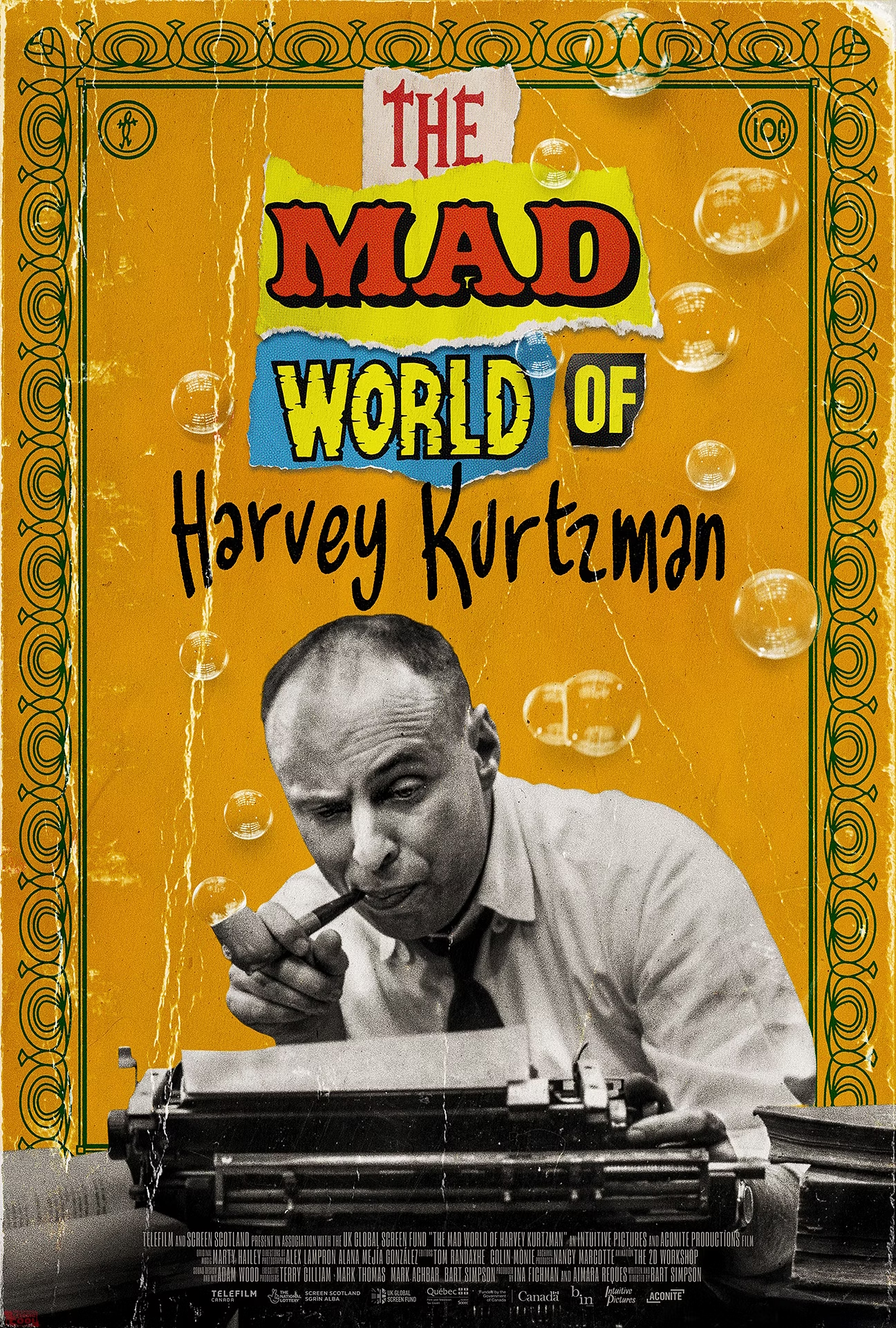
He helped transform American satire by taking the conventions of popular culture and turning them inside out, which makes the new documentary The Mad World of Harvey Kurtzman an essential piece of the puzzle for anyone interested in where modern pop-culture parody actually came from. Without Kurtzman’s disruptive, rule-breaking work, the pop-culture parody we take for granted today would look very different, and there is a pretty good argument that much of it wouldn’t exist in the form we know.
Before MAD Was MAD
The interesting thing about Kurtzman is that he didn’t begin by creating the MAD Magazine most of us remember. The original MAD appeared in 1952 as a comic book from EC Comics, where Kurtzman was allowed to create a humor publication and promptly decided that the comic-book industry itself would make a pretty good target.
Movies, war comics, romance comics and other familiar genres became targets, but the joke wasn’t simply inside the story. The entire machinery of the comic book could become the joke, which was a pretty radical idea at a time when comic books were generally expected to follow certain rules about what they were supposed to be.
Kurtzman understood that you could take something people already knew, strip away the seriousness surrounding it and expose the formula underneath. Once you saw the formula, you couldn’t really unsee it, and that became one of the great secrets behind MAD‘s influence.
Kurtzman also had some extraordinary artists helping him make the point. Will Elder, Jack Davis and Wally Wood helped establish the visual language that made early MAD so different from anything else on the newsstand, while Elder’s ridiculously crowded panels were especially important because there could be jokes hiding everywhere.
You could find something in the foreground, something else in the background and another completely ridiculous detail tucked into a corner that you didn’t notice until your third or fourth reading. The joke wasn’t always sitting there waiting for you because sometimes you had to go looking for it, and for a kid, that was gold.
Then MAD Became a Magazine
There is another fascinating twist in the story because the MAD that eventually became an institution wasn’t quite the same publication Kurtzman created. In 1955, MAD switched from a comic book to a magazine after Kurtzman received another publishing offer, and publisher William Gaines agreed to the change to keep him at EC.
The new format also had an unexpected advantage because magazines were outside the Comics Code system. Kurtzman’s relationship with Gaines eventually broke down, however, and he left MAD in 1956. That means the guy who created the thing didn’t stick around to watch it become the cultural monster it eventually became.
Al Feldstein took over as editor, and MAD developed into the magazine most people remember. The famous Usual Gang of Idiots would go on to create an enormous body of work, with artists and writers such as Al Jaffee, Mort Drucker and Antonio Prohias helping turn the magazine into an American institution.
Kurtzman created a kind of DNA, and other people took that DNA and built the organism. That distinction matters because it is very easy to look at MAD today and assume it was always the same thing, when in reality Kurtzman’s version was more experimental and more aggressively interested in dismantling the conventions of popular culture.
The magazine that followed became broader, more polished and much more successful commercially, but the original idea was still sitting underneath everything. Make fun of the formula, expose the machinery and never assume that something deserves respect simply because everyone else is treating it seriously.
And Then There Was Alfred
Of course, you can’t talk about MAD without talking about Alfred E. Neuman. That strange little kid with the vacant grin and the What, me worry? attitude became one of the most recognizable faces in American satire, even though the character’s history goes back much further than MAD.
Kurtzman encountered an existing gap-toothed image and began using variations of it in MAD, while the character’s familiar name, appearance and personality developed further under Al Feldstein and artist Norman Mingo. Alfred eventually became the visual embodiment of the MAD philosophy, which may be one of the most appropriate things that could have happened to the magazine.
He looked like the exact opposite of the polished, serious people who dominated advertising and popular culture. While everybody else was trying to sell you something, Alfred looked like he had already decided none of it mattered, and that made him the perfect mascot for a magazine devoted to poking holes in everything.
You didn’t have to be sophisticated to see through the nonsense, and maybe being too sophisticated was part of the problem. There is something wonderfully subversive about making the mascot of a major magazine look like the kid who would probably be sitting at the back of the classroom drawing cartoons while everybody else was paying attention.
That was MAD. It didn’t ask you to become an expert before you were allowed to laugh at something because sometimes all you needed was a pair of eyes and the suspicion that the adults might be taking themselves a little too seriously.
Kurtzman’s Cultural Family Tree
What makes Kurtzman’s story even more remarkable is what happened after MAD. He became a kind of cultural godfather to people who would go on to reshape American comedy, comics and popular culture, and his later work on Help! became another important gathering place for young artists, writers and performers.
Help! brought Kurtzman into contact with people including Terry Gilliam, Gloria Steinem, Woody Allen, John Cleese and Robert Crumb, helping create another unlikely crossroads in the history of American comedy and alternative culture. Kurtzman wasn’t simply a guy who created MAD and then disappeared from the cultural conversation because his influence kept showing up in unexpected places.
And then there is Terry Gilliam. Gilliam has talked about discovering Kurtzman’s work as a teenager and the profound influence it had on his own visual imagination, and when you know that connection, you start seeing the family resemblance.
The cut-and-paste absurdity, the deliberately broken sense of reality and the collision of images and ideas that shouldn’t logically belong together all have a family resemblance. You can draw a line from Kurtzman’s drawing board to MAD, from MAD to underground comics, from underground comics to alternative comics, and from all of that into the strange visual language that eventually became part of modern comedy.
That is quite a legacy for a guy who spent his career making fun of things. Kurtzman wasn’t simply producing jokes for one generation because he was giving other creative people permission to look at the world differently and then do something with what they saw.
He Changed the Way We Looked at Things
This may actually be Kurtzman’s greatest contribution. He didn’t simply teach people how to make jokes about movies, television and advertising because he taught audiences to recognize the machinery behind them and to understand that popular culture was built from formulas that could be examined, questioned and, if necessary, completely dismantled.
The polished corporate image of 1950s America could be pulled apart and exposed for what it was. The advertising slogan could be turned inside out, the movie cliché could become the entire punchline and the comic-book hero could suddenly look ridiculous.
You were no longer simply consuming pop culture because you were looking at it. Film critic Roger Ebert, among others, credited MAD with helping teach him how to look at the world, which is a pretty remarkable thing for a publication built around drawings, jokes and a willingness to make fun of almost everything.
It also explains why MAD mattered so much to kids. When you’re young, you don’t necessarily have the vocabulary to explain what you’re seeing, but you know something feels wrong when everybody is telling you that the commercial is supposed to make you want the product, the movie is supposed to make you feel a certain way and the celebrity is supposed to be important.
Then you pick up MAD and suddenly somebody is saying, Yeah, but look at this. That little shift in perspective can stay with you for the rest of your life, because once you learn to question the machinery behind the joke, you start noticing the machinery everywhere.
So Why Harvey Kurtzman Now?
That is what makes The Mad World of Harvey Kurtzman so interesting. Director Bart Simpson, and yes, that really is his name, has created a vivid and visually striking portrait of a restless, uncompromising creative force, with executive producer Terry Gilliam and support from organizations including Telefilm Canada, Screen Scotland and the BFI.
The documentary doesn’t simply sit there and tell us about Kurtzman’s work because it tries to capture what made the work feel alive in the first place. The production uses handcrafted animation alongside material from private archives, bringing Kurtzman’s artwork off those familiar yellowing pages and into motion.
That feels like exactly the right approach. Kurtzman’s work was never meant to sit quietly behind glass in a museum because it was meant to attack things, move quickly and make you look twice.
The documentary’s festival material describes Kurtzman’s lifelong determination to challenge the status quo as a much-needed hymn for our times, and I have to admit that description doesn’t feel like much of a stretch. We live in an era where creative work is constantly being squeezed between commercial expectations, algorithms, branding and whatever the latest metric happens to be.
There are more ways than ever to make something, but there are also more reasons than ever to make something that somebody else has already decided will be safe. Kurtzman was not particularly interested in safe, and that is probably why his story feels so timely.
The Kid Who Picked Up MAD
There is a funny thing about discovering MAD when you’re a kid because at the time, you think you’re just reading a funny magazine. You don’t realize that you’re being taught a way of looking at the world, and you certainly don’t realize that all those movie parodies, ridiculous advertisements, visual gags and smart-ass comments are quietly teaching you that nothing is too important to question.
You don’t realize that the joke isn’t always the end of the story because sometimes the joke is the beginning of seeing something differently. For a kid growing up in the 1970s, that was a pretty powerful thing to discover, especially when so much of the world around you was telling you to simply accept what you were being shown.
That is Harvey Kurtzman’s real legacy. He wasn’t just making fun of movies or comic books or advertising because he was teaching people to look behind the curtain, question the formula and understand that the culture around them didn’t have to be taken at face value.
And maybe that’s why the story of Harvey Kurtzman still matters. The kid who picked up MAD thought he had found a funny magazine, but what he had really found was permission to laugh at the machinery of the world around him.
It is about damn time somebody gave Harvey Kurtzman the spotlight.
Recommended Reading
More from Sandbox World
- The MAD Files: Writers and Cartoonists on the Magazine That Warped America’s Brain – A natural companion covering MAD’s creators, cultural impact and the legacy of the Usual Gang of Idiots.
- Mad Magazine Artist Al Jaffee Turns 100 Years – A look at one of the most important artists in MAD history and the man behind the legendary Fold-In.
- Al Jaffee, the Creator of MAD’s Classic Fold-Ins, Is Dead at the Age of 102 – A deeper look at Jaffee’s extraordinary career and his six decades with MAD.
- Mad Magazine: What, Me Worry? – A lighter trip into MAD history, exploring the magazine’s unusual musical offshoots and its place in pop-culture history.
Further Reading
- The Mad World of Harvey Kurtzman | Screen Scotland – Official production information and contributors.
- Humor in a Jugular Vein | Library of Congress – Institutional background on MAD, Kurtzman and EC Comics.
- EC Comics History – Background on EC Comics and the birth of MAD.
- The MAD Files | Library of America – Publisher information on the collection examining MAD and its cultural influence.
Discover more from Sandbox World
Subscribe to get the latest posts sent to your email.